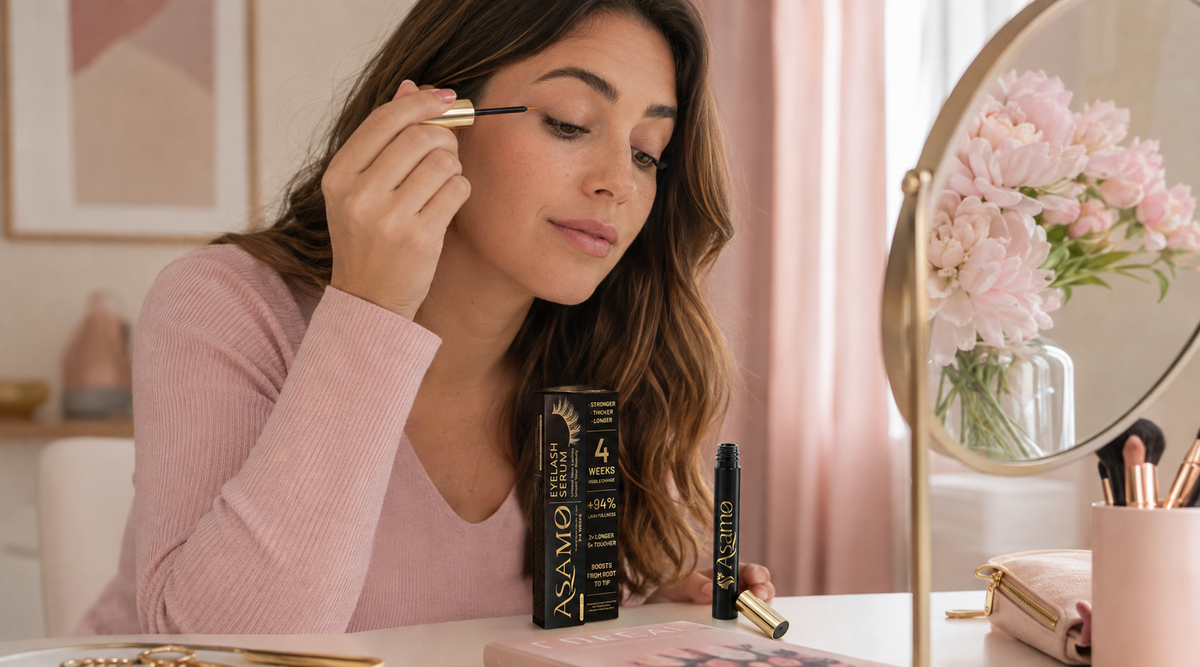
“Patch test lash serum” is a practical question because lash care products are used close to a sensitive area. A patch test can help you notice an obvious skin reaction before adding a new product to your full routine, but it cannot guarantee that you will never have a reaction later.
For lash serum and other eye-area products, follow the product’s own instructions first. Do not patch test on the eyelid, lash line, inner waterline, or in the eye. If the label provides a specific test method, location, or timing, use that method instead of general online advice.
This guide focuses on everyday cosmetic use, routine safety, texture, hygiene, and label reading. It does not diagnose conditions or promise treatment, permanent change, or results within a fixed time. Any ASAMO product-specific statement should match the final formula, packaging, directions, and finished-product documentation.
Quick Answer: Should You Patch Test Lash Serum?
A patch test may help identify an obvious skin reaction before you begin using a new product in your normal routine. It does not guarantee that you will never react later, and it does not replace the lash serum’s product-specific safety directions.
For an eye-area product:
-
Read the label first.
-
Follow any patch-test instructions supplied by the brand.
-
Do not test on your eyelid, lash line, inner waterline, or eye.
-
Do not use the product if you have an eye infection or inflamed skin around the eye.
-
Stop if a test area becomes red, itchy, swollen, painful, or otherwise concerning.
-
Seek appropriate professional guidance for a severe, persistent, or concerning reaction.
The American Academy of Dermatology recommends testing a new skin-care product on a small, less visible area of skin before regular use, while recognizing that a reaction can still occur later. Read the AAD’s at-home skin-care testing guidance.
A Patch Test Is Not a Guarantee
A successful patch test can be useful, but it does not prove that a product will always feel comfortable in the eye area.
Why? Your everyday routine may differ from the test conditions. You may use the product with mascara, eye cream, sunscreen, contact lenses, makeup remover, or other products. Your skin and surroundings can also change over time.
A patch test can help you ask a practical question:
Does this product appear to cause an obvious reaction on a small external test area before I add it to my usual routine?
It cannot answer every question about eye-area use, formula compatibility, or future comfort.
Do not treat a negative patch test as permission to ignore the product label or apply the product outside its intended area.
Start With the Product Label
The label is the first step for every new lash serum.
Before considering a patch test or first use, check:
-
The intended application area
-
Directions for use
-
Warnings and precautions
-
Any label-specific test method
-
Recommended frequency
-
Whether morning or evening use is suggested
-
Instructions for accidental eye contact, if provided
-
Storage instructions
If the label provides a specific patch-test method, use that method. If it says not to patch test, or does not provide enough information for you to feel confident about testing an eye-area product, contact the brand for product-specific guidance.
Do not use another brand’s instructions as a substitute for the product you have.
Where Should You Patch Test?
Never patch test lash serum on the eyelid, lash line, inner waterline, or eye.
For general skin-care testing, the American Academy of Dermatology recommends choosing a small external area where product will not easily rub or wash away, such as the underside of the arm or the bend of the elbow. Read the AAD’s at-home skin-care testing guidance.
However, lash serum is an eye-area product, so the label takes priority. If the brand gives different instructions, follow those instructions.
The purpose of a patch test is not to recreate lash-line use. It is to check for a noticeable reaction on a small external skin area before introducing a new product into a routine.
A General At-Home Patch Test Method
Use the following only when the product label does not provide a different method and does not advise against testing.
-
Read the product label and warnings.
-
Choose a small external area of intact skin away from the eyes.
-
Apply only a small amount of product.
-
Do not apply the test product to broken, irritated, or inflamed skin.
-
Leave the product on for the same amount of time you would normally leave it on, unless the label directs otherwise.
-
Observe the area over the testing period.
-
Stop using the product if the area becomes red, itchy, swollen, painful, or otherwise concerning.
The American Academy of Dermatology’s general method for new skin-care products is to test a small spot twice daily for seven to 10 days, using the product as it would normally be used. Read the AAD’s at-home skin-care testing guidance.
This is a general skin-care approach, not a replacement for the lash serum label.
Do Not Patch Test in the Eye Area
The eye area is sensitive, and a home patch test should not become an experiment on the eyelid or lash line.
Do not:
-
Apply a test amount on the eyelid.
-
Apply product to the lash line unless you are using it according to the label’s full directions.
-
Apply product to the inner waterline.
-
Put product into the eye.
-
Test directly over an irritated area.
-
Apply a thicker amount to “make sure” you react.
-
Use multiple new products on the same test spot.
-
Continue testing if discomfort begins.
If you have a history of reactions to cosmetics, sensitive skin, eye irritation, or uncertainty about an eye-area product, seek product-specific or professional guidance instead of trying to create your own test method.
What Should You Watch For?
A patch test is intended to help you notice a visible or uncomfortable response before routine use.
Stop using the product if you notice:
-
Redness
-
Itching
-
Swelling
-
A rash
-
Burning or persistent stinging
-
Pain
-
Blistering
-
A reaction that worsens over time
-
Any symptom that feels concerning
Do not dismiss a reaction as a sign that the product is “working.”
The FDA advises consumers to stop using eye cosmetics if irritation occurs and to see a doctor if irritation persists. Read the FDA’s Eye Cosmetic Safety guidance.
What to Do If You React During a Patch Test
If you notice a reaction on the test area, gently remove the product as appropriate and do not use it again.
Do not try to test the product on another area to see whether the same reaction occurs. Do not apply a smaller amount to the lash line in an attempt to “confirm” the reaction. Do not mix it with another skincare product to change the outcome.
Keep the routine simple and seek appropriate professional guidance if the reaction is severe, persistent, or concerning.
The American Academy of Dermatology advises gently washing off a skincare product if a reaction develops and not using it again. Read the AAD’s at-home skin-care testing guidance.
Do Not Patch Test if the Eye Area Is Already Inflamed
Avoid using eye-area cosmetics if the eye itself is irritated or if the skin around the eye is inflamed.
The FDA advises consumers to avoid eye cosmetics when there is an eye infection or inflammation around the eye, and to wait until the area has healed. Read the FDA’s Eye Cosmetic Safety guidance.
Do not use a patch test as a way to work around an active eye-area issue.
If you have ongoing redness, pain, discharge, eye symptoms, vision changes, or another concerning symptom, seek appropriate professional guidance.
Introduce One New Product at a Time
A patch test is more useful when you are not adding several new products at once.
If you are introducing lash serum, keep the rest of your eye-area routine familiar at first. Avoid adding a new eye cream, mascara, makeup remover, eyeliner, and lash serum at the same time.
This makes it easier to notice practical routine details:
-
Does the product feel comfortable?
-
Does it settle before the next step?
-
Does makeup apply normally afterward?
-
Does the product move outside the intended area?
-
Does the routine pill or feel heavy?
-
Is the applicator easy to keep clean?
Change one variable at a time. It is the clearest way to understand how a product fits your routine.
Use a Small Controlled Amount for First Use
A patch test is not a reason to use more product on the lash line.
When you begin using a lash serum according to its label, start with the smallest suitable amount. Apply it only in the intended external area, avoid repeated passes, and let it settle before adding another nearby product.
Excess product can move, transfer, feel heavy, or interfere with nearby skincare and makeup. More product does not make the routine safer or better.
If the product remains visibly wet, moves easily, or affects mascara application, reduce the amount before changing everything else.

Keep the Applicator Clean
Good hygiene is part of responsible eye-area cosmetic use.
Wash and dry your hands before opening lash serum. Keep the applicator away from fingers, countertops, towels, makeup residue, and other unclean surfaces. Close the product promptly after use, and do not share it.
The FDA advises consumers to wash hands before applying eye cosmetics, keep applicators clean, and avoid sharing eye-area products. Read the FDA’s Eye Cosmetic Safety guidance.
Do not add water, saliva, makeup remover, alcohol, or another cosmetic product into lash serum packaging.
Patch Testing and Contact Lenses
If you wear contact lenses, a patch test does not tell you whether the product will feel comfortable while lenses are in place.
Follow the lash serum label and your contact lens-care instructions. If the product does not clearly address contact lens wear and you are unsure, a more cautious option may be to use the lash serum in an evening routine after removing lenses according to your lens-care directions.
Do not apply lash serum directly onto a contact lens, into the eye, or onto the inner waterline.
If you experience redness, pain, unusual tearing, discharge, vision changes, or another concerning eye symptom, stop using the lash serum and seek appropriate professional guidance.
Separate Product Feel From Product Claims
A smooth texture, lightweight feel, cooling sensation, or comfortable routine can be useful personal observations. They are not proof of a specific biological effect.
A patch test result is also not proof of a product’s effectiveness. It is only one cautious step to help notice an obvious reaction before regular use.
It helps to separate:
-
What the product feels like
-
Whether it appears comfortable on a small external test area
-
What the label says it is intended for
-
What finished-product evidence supports any specific claim
Do not use a patch test result to make treatment, performance, or guaranteed-result claims about a product.
How to Include ASAMO Lash Care in a Careful Routine
ASAMO lash care should be presented as part of a simple, label-led routine. Patch testing can be an optional cautious step when it is consistent with the current product label, but it does not replace the label or guarantee a future reaction will not occur.
Start by checking the current ASAMO product label. If it provides a patch-test method, follow that method. If not, do not test near the eyes. When introducing ASAMO lash serum into a regular routine, use a small controlled amount only in the label-directed external area and keep the applicator clean.
Before first use: Read the Label → Follow Any Product-Specific Test Instructions → Do Not Test Near the Eye.
Everyday routine: Clean Hands → Apply ASAMO Lash Serum as Directed → Let It Settle → Close and Store Cleanly.

When to Seek Professional Guidance
Seek appropriate professional guidance if you have a severe, persistent, or concerning reaction.
Get urgent care for symptoms such as trouble breathing, significant swelling, nausea, vomiting, or another severe reaction. The American Academy of Dermatology notes that these can be signs of a serious allergic reaction. Read the AAD’s patch-testing guidance.
For eye-related symptoms, persistent irritation, significant redness, swelling, pain, discharge, or vision changes, stop using the product and seek appropriate professional guidance promptly.
Frequently Asked Questions
Should I patch test lash serum?
A patch test may help you notice an obvious skin reaction before regular use, but it cannot guarantee that you will never react. Follow the lash serum label first and do not test near the eyes.
Where should I patch test lash serum?
Never on the eyelid, lash line, inner waterline, or eye. If the product label does not provide another method, a small external area away from the eyes—such as the underside of the arm or bend of the elbow—is a general skin-care testing option.
How long should I patch test a lash serum?
Follow the product label if it provides a test method. For general skin-care testing, the American Academy of Dermatology recommends testing a small area twice daily for seven to 10 days.
Can I patch test directly on my lash line?
No. Do not use the lash line, eyelid, inner waterline, or eye as a patch-test area.
Does a successful patch test mean I cannot react later?
No. A patch test can help identify an obvious reaction, but it cannot guarantee that your skin or eye area will never react later.
What should I do if the test area becomes red or itchy?
Stop using the product, gently remove it as appropriate, and do not test it again in another area or near the eye. Seek appropriate professional guidance if the reaction is severe, persistent, or concerning.
Can I use lash serum if my eye area is already irritated?
Avoid eye-area cosmetics if your eye is irritated or the skin around the eye is inflamed. Wait until the area has healed and seek appropriate professional guidance when needed.
Can I patch test lash serum while wearing contact lenses?
A skin patch test does not determine compatibility with contact lenses. Follow the lash serum label and your lens-care directions, and do not apply lash serum onto lenses or into the eye.

Final Thoughts
A patch test can be a useful cautious step before adding a new lash serum to your routine, but it is not a guarantee of future comfort or safety.
Follow the product label first. Do not patch test on the eyelid, lash line, inner waterline, or eye. Use a small controlled amount when beginning regular use, keep the applicator clean, and stop using the product if you notice a concerning reaction.
Share:
What to Do If Lash Serum Feels Uncomfortable
Botanical Extracts in Lash Serum: How to Read the Label