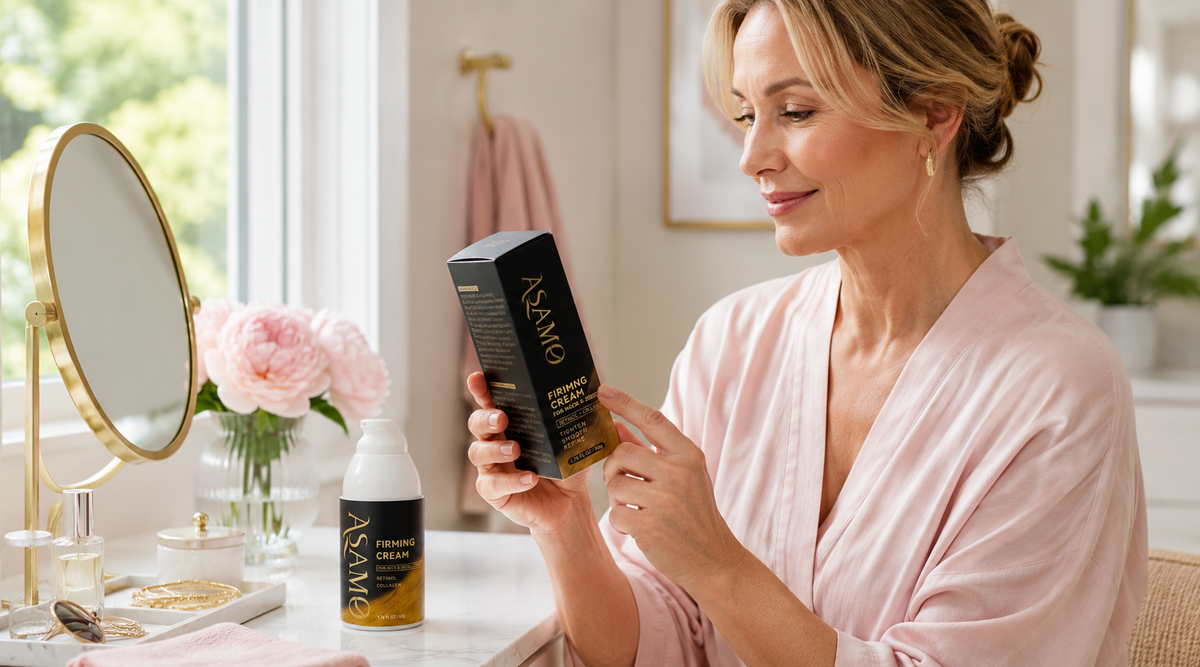
Learning how to read cosmetic ingredients can help you compare products, identify ingredients you prefer or want to avoid, and understand what a label can—and cannot—tell you.
An ingredient list is useful, but it is not a complete formula blueprint. A single ingredient name cannot reveal the finished product’s exact concentration, stability, delivery system, texture, or final performance. A better evaluation combines the ingredient declaration with the product’s directions, warnings, packaging, texture, intended use, and evidence supporting its claims.
This guide focuses on cosmetic labels, everyday use, texture, routine order, comfort, hygiene, and claim interpretation. It does not diagnose skin conditions or promise treatment, permanent change, or results within a fixed period. Any ASAMO product-specific statement should be reviewed against the final formula, packaging, instructions, and finished-product testing before publication.
Quick Answer
Do not evaluate a cosmetic product by searching for one featured ingredient and stopping there.
Read the complete ingredient declaration, but also check:
-
What area the product is intended for
-
How the label directs you to use it
-
Which warnings apply
-
What the packaging protects or dispenses
-
How the finished texture fits your routine
-
What evidence supports the product’s specific claims
In the United States, cosmetic ingredients are generally declared in descending order of predominance. However, ingredients present at 1% or less and color additives have specific ordering exceptions. This means the list can provide a broad picture of the formula, but it usually cannot tell you an ingredient’s exact percentage.
What Is an Ingredient Declaration?
The ingredient declaration is the part of the cosmetic label that identifies the ingredients used in the product. People often refer to this as the “INCI list,” although ingredient naming and labeling requirements can vary between markets.
INCI stands for International Nomenclature Cosmetic Ingredient. It provides standardized names that help manufacturers and consumers identify cosmetic ingredients across products and markets. However, consumers should not assume that every label worldwide will use identical wording or formatting.
The ingredient declaration is different from:
-
The product name
-
Front-of-package marketing language
-
Directions for use
-
Warning statements
-
A list of featured or “hero” ingredients
-
A separate Drug Facts panel on a product regulated as a drug or as both a cosmetic and a drug
A short list of ingredients highlighted on a product page is not necessarily the complete ingredient declaration. Look for the full list on the package or an official product page.
How Are Cosmetic Ingredients Ordered?
For cosmetics sold at retail in the United States, ingredients are generally listed in descending order of predominance. In other words, ingredients present in larger amounts usually appear before ingredients present in smaller amounts.
However, the rule includes important exceptions:
-
Ingredients present at more than 1% are generally listed in descending order.
-
Ingredients present at 1% or less may be listed in any order after those present at more than 1%.
-
Color additives may be listed in any order after the other ingredients.
The FDA explains these rules in its current summary of cosmetic labeling requirements.
This is why an ingredient’s exact position should not be converted into a precise concentration estimate. An ingredient near the end is not automatically present at the lowest concentration, and two ingredients appearing next to each other are not necessarily present at nearly identical percentages.
Why the “1% Line” Is Not Visible
Ingredient lists do not normally contain a divider showing where ingredients at 1% or less begin. Consumers sometimes try to identify a familiar preservative, thickener, or colorant and use it as a marker, but this remains an estimate.
Formula design varies, and the same ingredient may be used at different levels or for different purposes in different products. Without information from the manufacturer, you usually cannot identify the exact 1% boundary from the ingredient list alone.
The safest conclusion is:
-
The beginning of the list can provide a broad sense of the formula’s major components.
-
The later portion usually cannot be ranked with the same confidence.
-
The list does not disclose exact percentages unless the brand separately provides them.
-
Position alone does not prove whether a finished product will meet a specific claim.
The First Ingredients Matter—but They Are Not the Whole Story
The first several ingredients often make up a substantial part of a cosmetic formula. They may help you understand whether the product is mainly water-based, oil-based, balm-like, or built around another type of base.
That information can be useful for anticipating texture. It still does not allow you to predict the complete experience.
A finished product’s behavior may also depend on:
-
The relationship between multiple ingredients
-
Emulsifiers and stabilizers
-
Film-forming ingredients
-
Thickeners
-
Preservative systems
-
pH
-
Manufacturing process
-
Packaging
-
Storage
-
The amount applied
-
The products layered before and after it
A formula is a system, not a collection of isolated ingredient stories.
One Ingredient Can Serve More Than One Function
An ingredient does not always have only one purpose. Depending on the formula, an ingredient may help with texture, appearance, stability, fragrance, preservation, moisturization, or another technical function.
This makes simplified online lists such as “good ingredients” and “bad ingredients” less useful than they appear. The presence of an ingredient does not tell you:
-
Why it was included
-
How much is present
-
How it interacts with the rest of the formula
-
Whether the finished product remains stable in its packaging
-
Whether the product’s claims have been tested
-
Whether the product will feel comfortable for a specific person
Ingredient education is useful when it provides context. It becomes misleading when it turns one name into a guaranteed verdict about the whole product.
Featured Ingredients Are Not the Full Formula
Product pages often emphasize a few recognizable ingredients. These featured ingredients can help explain the brand’s formulation story, but they should not replace the complete declaration.
When you see a featured ingredient, ask:
-
Is it actually present in the full ingredient list?
-
Is the brand describing its role carefully?
-
Is the claim about the ingredient or the finished product?
-
Does the brand provide appropriate support for the finished-product statement?
-
Are important conditions or limitations clearly stated?
Research involving an ingredient does not automatically prove that every cosmetic containing that ingredient will perform the same way. Concentration, stability, formulation, packaging, test design, application amount, and use conditions all matter.
Ingredient Order Does Not Equal Effectiveness
A common mistake is assuming that an ingredient placed higher on the list must be more effective. Order generally relates to predominance, not proven performance.
A higher position does not reveal:
-
Whether the ingredient is stable
-
Whether the formula delivers it as intended
-
Whether the amount is appropriate for the product’s stated purpose
-
Whether the complete product has been tested
-
Whether the product is suitable for a particular use area
-
Whether a consumer will find the texture comfortable
Likewise, a lower position does not automatically mean an ingredient is useless. Different ingredients serve different technical purposes and may be used at different levels.
The ingredient declaration can help you ask better questions. It cannot replace finished-product evidence.
Understand “Fragrance,” “Flavor,” and Similar Collective Terms
In the United States, fragrance and flavor components may sometimes be declared collectively as “fragrance” or “flavor” rather than listing every component individually. The FDA’s cosmetics labeling guide explains these declaration rules and other labeling exceptions.
If avoiding fragrance is important to you, read the complete label and any information the manufacturer provides. Do not rely only on front-of-package terms or assume that the absence of a botanical-sounding fragrance ingredient means the product has no fragrance components.
Terms used in marketing and terms used in the formal ingredient declaration serve different purposes.
Botanical Names Can Look Complicated
Botanical ingredients may appear under standardized names that include the plant’s Latin name, plant part, and material type, such as an extract, oil, water, or powder.
That detail helps identify what is actually used. It does not prove that a botanical ingredient is automatically gentler, stronger, safer, or more effective than a non-botanical ingredient.
When reading a botanical name, look for:
-
The plant identity
-
The part used, if stated
-
Whether it is an extract, oil, water, powder, or another material
-
Its position within the complete declaration
-
The finished product’s directions and warnings
“Natural” and “botanical” are not substitutes for a complete safety, stability, or performance evaluation.
Distinguish Cosmetics From Products With Drug Facts
Some products are regulated as cosmetics, some as drugs, and some as both cosmetics and drugs. A product with drug uses may have a Drug Facts panel that separately identifies active ingredients and inactive ingredients.
Do not read a Drug Facts panel using the same assumptions as a standard cosmetic ingredient declaration. Follow the product’s labeled directions and warnings.
In the United States, intended use and product claims help determine how a product is regulated. The FDA states that claims about treating or preventing disease, or affecting the structure or function of the body, can cause a product to be regulated as a drug. Cosmetic label claims must also be truthful and not misleading. Read the FDA’s cosmetic labeling claims guidance.
A term such as “cosmeceutical” does not create a separate legal product category under U.S. law.
Read Claims Separately From Ingredients
A product’s ingredient declaration tells you what ingredients are declared. Its claims tell you what the brand says the product does. These are related, but they are not interchangeable.
A responsible evaluation separates three levels:
| Information level | What it can tell you |
|---|---|
| Label directions and warnings | Where, when, and how the product should be used |
| Observable product characteristics | Texture, scent, spreadability, finish, packaging, and layering |
| Evidence-dependent claims | Specific finished-product performance under defined conditions |
A brand should not use the presence of one fashionable ingredient as automatic proof of a broad finished-product claim. The evidence should match the specificity of the wording.
Packaging Is Part of Formula Evaluation
The ingredient list does not tell you everything about how the product is protected or dispensed. Packaging can influence exposure to air, light, heat, moisture, and repeated contact during use.
When comparing products, consider:
-
Pump, tube, jar, dropper, wand, or brush packaging
-
Whether the package closes securely
-
Whether the amount is easy to control
-
Whether the applicator can be kept clean
-
Whether the label remains available during use
-
Whether the product has specific storage directions
Packaging alone does not prove superior performance, but it is part of the finished product and should be considered alongside the formula.
Texture Provides Information the Ingredient List Cannot
A label cannot fully predict how a product will spread or layer. Liquids, gels, lotions, creams, oils, and balm-like textures can behave differently even when they share some ingredients.
| Texture | What you may observe | What you cannot conclude from texture alone |
|---|---|---|
| Fluid | Fast spreading or a light surface feel | That it is stronger or more effective |
| Gel | Cooling or smooth application | That it contains a higher level of a featured ingredient |
| Lotion | Moderate slip and a lighter finish than some creams | That it is suitable for every routine |
| Cream | A richer or more substantial finish | That it produces a greater biological effect |
| Balm-like texture | A noticeable final film | That it permanently changes the skin |
Texture can help you decide where a product fits in a routine. It should not be used as evidence for an untested claim.
How Ingredient Reading Fits Into Routine Order
An ingredient list does not usually tell you the exact order in which to layer products. Use the directions and actual textures instead.
“Lighter to richer” can be a useful starting point, but it is not an absolute rule. A practical routine might include:
-
Cleansing
-
A label-appropriate lightweight leave-on product
-
Moisturizer if needed
-
Sunscreen in the daytime according to its own label
You do not need to use every product category. A product should be added because it has a clear purpose and comfortable position—not because its ingredient list is long or contains a popular ingredient.
Use the Smallest Appropriate Amount
The ingredient declaration does not establish a universal amount. Packaging and directions matter.
Different pumps, tubes, jars, droppers, and applicators dispense different quantities. Begin with the smallest label-appropriate amount that spreads evenly over the intended area.
Overapplication can create:
-
Sliding
-
Pilling
-
Transfer to clothing
-
A heavy surface feel
-
Makeup movement
-
Difficulty understanding which layer caused a problem
Do not assume that applying more increases effectiveness.
Introduce One New Formula at a Time
If you add several new products together, the ingredient lists will not tell you which formula caused pilling or discomfort.
Keep the rest of your routine familiar and introduce one product at a time. Observe:
-
Texture
-
Spreadability
-
Surface feel
-
Compatibility with moisturizer
-
Compatibility with sunscreen or makeup
-
Comfort in the intended area
-
Any persistent or concerning reaction
This creates more useful information than trying to compare several ingredient lists after a problem appears.

Ingredient Lists Cannot Predict Pilling by Themselves
Pilling usually relates to the interaction between formula texture, product amount, friction, settling time, and surrounding layers.
If products pill, test one variable at a time:
-
Use less of one product.
-
Reduce repeated rubbing.
-
Allow the previous layer to stop feeling excessively wet.
-
Remove one overlapping layer.
-
Test how skincare works beneath sunscreen or makeup.
Do not assume that one ingredient is responsible based only on its name. Pilling is usually a finished-routine issue rather than proof that a particular ingredient is “bad.”
Do Not Use Sensation as Evidence
Cooling, tingling, smoothness, richness, or a temporary tightening sensation can influence product experience. These sensations do not automatically prove a specific biological effect.
In particular, burning, persistent stinging, marked redness, or swelling should not be described as evidence that a product is working.
If a product causes persistent or concerning discomfort, stop using it. Cleanse or rinse as appropriate, review the label, and seek professional guidance when needed. If symptoms are severe or involve the eyes, seek timely professional help.
Keep Ingredient Labels Available
Do not transfer products into unmarked containers if doing so removes the ingredient declaration, directions, warnings, batch information, or product identity.
When traveling, consider taking a clear photograph of the original package if you must use a smaller container. The container should still be clean, suitable for cosmetics, and clearly identified.
Keep product openings and applicators clean, close packages promptly, and avoid allowing droppers, brushes, or wands to touch unclean surfaces.
Never add water, saliva, or another cosmetic to change a product’s texture. This may affect the formula and increase contamination risk.
Recheck Labels When Products Change
A familiar product may be reformulated, repackaged, or given updated directions. Do not assume that an ingredient list saved months ago still reflects the product currently being sold.
Compare the ingredient declaration on the package you actually own with the brand’s current official information. Pay attention to:
-
Formula or packaging updates
-
Changes in directions
-
New warnings
-
Different regional versions
-
Different shades, scents, or product variants
A review of the correct product version is more useful than comparing screenshots from unknown sellers or old listings.
A Practical Ingredient-Reading Checklist
Use this sequence when evaluating a cosmetic:
-
Confirm the exact product and variant.
-
Identify the intended use area.
-
Read directions and warnings.
-
Find the complete ingredient declaration.
-
Review the first several ingredients for broad formula context.
-
Remember the exceptions for ingredients at 1% or less and color additives.
-
Do not estimate exact percentages from list position.
-
Check the packaging and texture.
-
Separate ingredient information from finished-product claims.
-
Decide whether the product has a clear place in your routine.
This process is more useful than rating a product from one featured ingredient or from the total number of ingredients.
How ASAMO Can Build an Ingredient Library
ASAMO can use ingredient education to help readers understand labels without turning individual ingredients into guaranteed product claims.
An ingredient library can explain:
-
Standard ingredient names
-
Common cosmetic functions
-
How an ingredient may contribute to formula texture or stability
-
Why complete formulation matters
-
The difference between ingredient research and finished-product evidence
-
Which statements still require confirmation from the final product formula and testing
Each ingredient page should link to a product only when the product actually contains the ingredient and the live URL has been verified. Product-specific claims must remain consistent with the current label, formula, packaging, and supporting evidence.

Frequently Asked Questions
How should I start reading a cosmetic ingredient list?
First confirm the exact product, intended use area, directions, and warnings. Then read the complete ingredient declaration instead of relying on the featured ingredients on the front of the package.
Are ingredients always listed from highest to lowest concentration?
Ingredients are generally listed in descending order of predominance, but ingredients present at 1% or less and color additives have ordering exceptions under U.S. labeling rules.
Can I find an ingredient’s exact percentage from its position?
Usually not. The list does not normally disclose exact percentages, and the flexible ordering of ingredients at 1% or less makes precise estimates unreliable.
Does an ingredient near the end of the list do nothing?
Not necessarily. Ingredients have different functions and may be used at different levels. Position alone does not establish usefulness or finished-product performance.
Does the first ingredient make up most of the product?
The first ingredient is generally present in greater predominance than the ingredients that follow under the applicable ordering rules, but the label usually does not disclose its exact percentage.
Does a longer ingredient list mean a better formula?
No. Ingredient count does not reveal concentration, stability, compatibility, finished-product performance, or suitability for a particular person.
Are botanical ingredients automatically gentler?
No. Botanical origin alone does not establish gentleness, safety, concentration, or finished-product performance. Read the entire label and follow the product directions.
Can I compare two products only by their ingredient lists?
You can identify similarities and differences, but the lists do not reveal exact percentages, manufacturing processes, stability, packaging effects, or complete performance.
Can an ingredient study prove that a cosmetic product works?
Not automatically. Ingredient research may explain why an ingredient is discussed, but a finished-product claim should be supported by evidence appropriate to the actual formula, use conditions, and wording.
Why does my label have an “Active Ingredients” section?
The product may be regulated as a drug or as both a cosmetic and a drug. Follow its Drug Facts panel, directions, and warnings rather than interpreting it like a standard cosmetic ingredient list.
Does tingling mean an ingredient is working?
No. Tingling or burning is not proof of effectiveness. Persistent discomfort is a reason to stop using the product and reassess.
When should I stop using a cosmetic?
Stop use if you experience persistent burning, marked redness, obvious swelling, eye symptoms, or another concerning reaction. Follow the label and seek professional guidance as appropriate.

The Takeaway
A cosmetic ingredient list is a valuable source of information, but it is not a complete formula blueprint or a guarantee of performance.
Use it to identify ingredients, understand the broad structure of a formula, and recognize personal preferences. Then combine that information with the product’s intended use, directions, warnings, packaging, texture, routine compatibility, and finished-product evidence.
Do not turn one ingredient name, its position, or the total number of ingredients into a certain conclusion. The most responsible reading considers the entire product.
Share:
The Complete Minimal Skincare Routine Guide