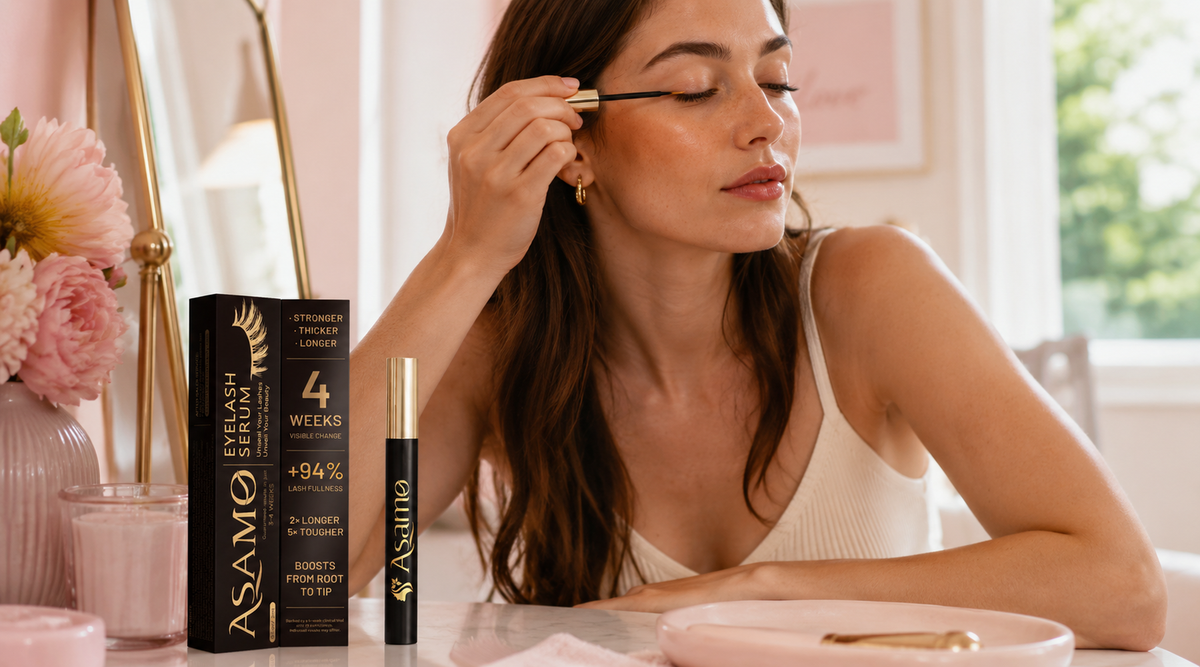
Buying a lash serum should start with practical questions—not with a trend, price tag, or one featured ingredient. A useful product is one that has clear instructions, fits comfortably into your routine, and can be applied cleanly to the intended external area.
Before purchasing, consider the texture you prefer, when you expect to use it, what products come next, and whether the packaging supports controlled and hygienic use. Then confirm your choice with the actual formula and label.
This article focuses on everyday cosmetic use, texture, layering, comfort, hygiene, and label reading. It does not diagnose conditions or promise treatment, permanent change, or a fixed timeline for results. Any ASAMO product-specific statement should be updated only after the final formula, directions, packaging, and finished-product testing are confirmed.
Quick Answer
Before buying a lash serum, ask whether its label is clear, whether its intended application area matches your needs, whether its texture works with your makeup routine, and whether its packaging helps you use it cleanly.
A good buying decision is based on:
-
The product’s directions and warnings
-
The intended external application area
-
Texture and dry-down feel
-
Applicator and packaging hygiene
-
Morning or evening routine fit
-
Makeup compatibility
-
The full INCI list, not one highlighted ingredient
-
Product-specific evidence for product-specific claims
The right lash serum is not necessarily the most popular or the most expensive. It is one you can use correctly, comfortably, and consistently according to its label.
Question 1: Is the Label Clear About Where to Apply It?
Start with the intended application area. The label should make it clear where the product belongs and how to use it.
Do not assume that every product called a lash serum is applied in the same location. A product’s brush shape, marketing image, or category name does not replace its directions.
A responsible label should help you understand:
-
Where to apply the product
-
How often to use it
-
How much to use
-
Important warnings or precautions
-
When to stop use
If any of these points is unclear, do not guess in a sensitive eye-area routine. Contact the brand or choose a product with more complete instructions.
Question 2: Does the Product Fit My Morning or Evening Routine?
There is no universal best time for every lash serum.
If you prefer a morning routine, consider whether the label permits morning use and whether the texture can settle before sunscreen or mascara. A product that stays visibly wet or transfers easily may be less convenient before makeup.
If you prefer evening use, consider whether the product fits after makeup removal and cleansing. Evening may be easier for people who regularly wear mascara, but you should still follow the label’s suggested frequency and amount.
Your routine should feel realistic. A product you can use comfortably in a simple routine is more useful than one that requires too many steps or conflicts with your usual schedule.
Question 3: What Texture Do I Prefer?
Texture affects how a product spreads, settles, layers, and feels. It does not automatically show that one serum is more effective than another.
| Texture experience | May suit | Practical consideration |
|---|---|---|
| Lightweight liquid | Minimal routines or makeup-focused mornings | Use a controlled amount to avoid movement |
| Serum-gel | People who prefer a little more cushion | Test how it settles before makeup |
| More conditioning feel | Evening routines or fewer makeup layers | May feel more noticeable during the day |
| Quick-set finish | Makeup wearers, if label allows morning use | Still allow it to settle before mascara |
Choose the texture you are most likely to use consistently according to the label. “Lightweight,” “refreshing,” or “conditioning” describe cosmetic experience, not guaranteed performance.
Question 4: What Type of Applicator Does It Use?
The applicator affects precision, amount control, storage, and hygiene. It does not decide the correct placement—the label does.
Fine Brush or Liner-Style Tip
A fine tip may help people who prefer a more targeted application. It can be convenient when you want controlled placement to the label-permitted external area.
Keep it away from unclean surfaces and do not assume it is intended for the inner waterline or eye itself.
Spoolie or Mascara-Style Wand
A spoolie-style applicator may feel familiar if you regularly use mascara. Depending on the product directions, it may distribute serum across lashes more broadly.
This style makes clean handling especially important. Do not share it or use it after the applicator has touched an unclean surface.
Pump, Tube, or Dropper
Some products use packaging that dispenses product before application. This may help you see how much you are using, but it can also make over-application easier.
Use only the smallest label-directed amount. More product can create a wet layer, transfer into nearby skincare, or make the routine harder to manage.
Question 5: Can I Keep the Packaging Clean?
For products used around the eyes, packaging convenience and hygiene should be part of the buying decision.
Ask yourself:
-
Does the cap close securely?
-
Is the applicator easy to keep clean?
-
Does the packaging dispense a controlled amount?
-
Can I store it without exposing it to heat or moisture?
-
Will I be tempted to touch the applicator to the sink, counter, or makeup bag?
-
Can I keep the original label and directions with the product?
The FDA advises consumers not to share eye cosmetics and to handle them carefully because contamination can create risks around the eyes. Read FDA eye cosmetic safety guidance.
Question 6: What Does the Full Ingredient List Tell Me?
The INCI list can help you identify ingredients you prefer or choose to avoid. However, it does not usually reveal exact concentration, stability, delivery system, or the complete behavior of the finished product.
Ingredient order provides some context. In the United States, cosmetic ingredients are generally listed in descending order of predominance, although ingredients at one percent or less may be listed in any order. FDA cosmetic labeling guidance explains this in more detail.
Do not buy a serum based only on a highlighted ingredient such as peptides, botanical extracts, caffeine, or another popular ingredient. Look at the full formula, label directions, packaging, and brand evidence together.
Question 7: What Claims Is the Brand Making?
Product claims should match the evidence available for the finished product. A general ingredient discussion is not the same as proof that a particular formula will provide the same result.
It helps to separate three types of information:
-
Label-directed facts
Intended use, application area, frequency, warnings, and storage instructions. -
Direct cosmetic observations
Texture, appearance, dry-down, packaging, makeup compatibility, and comfort. -
Claims needing product-specific support
Objective performance statements, fixed timelines, permanent changes, or claims beyond ordinary cosmetic care and appearance.
Be cautious with words such as “guaranteed,” “permanent,” “clinically proven” without clear context, “fastest,” or “strongest.” A responsible buying decision does not depend on exaggerated certainty.
Question 8: Will It Work With My Makeup Habits?
If you wear mascara, test or plan for compatibility before making the product part of your daily morning routine.
A serum may fit before mascara if its label allows morning use and it settles comfortably. There is no universal number of minutes to wait. Instead, wait until the product is no longer visibly wet, moving, or likely to mix with the next layer.
To assess compatibility after purchase:
-
Keep your usual makeup routine the same.
-
Introduce only the new lash serum.
-
Use the smallest suitable amount.
-
Let it settle.
-
Apply mascara gently.
-
Observe transfer, flaking, skipping, pilling, or heaviness.
If makeup becomes unreliable, reduce the amount, simplify nearby layers, or consider evening use if the label permits it.
Question 9: Am I Willing to Start Slowly?
A new lash serum should be one change in your routine—not one of several new products introduced on the same day.
Keeping the rest of your routine familiar makes it easier to observe:
-
Whether the texture feels comfortable
-
Whether makeup changes
-
Whether the product settles well
-
Whether pilling occurs
-
Whether you notice dryness, burning, redness, or another concern
If you change serum, mascara, cleanser, and eye cream at the same time, it becomes difficult to tell which change caused a problem.
Question 10: What Will I Do if It Does Not Feel Comfortable?
Have a clear stop rule before you buy. Do not continue using an eye-area product because discomfort is described online as a sign that it is “working.”
Stop use if the label directs you to do so or if you experience persistent burning, clear swelling, significant redness, eye symptoms, or another concerning reaction. If symptoms are severe, persistent, or involve the eye, seek timely advice from an appropriate healthcare professional.

A Simple Lash Serum Buying Checklist
Before purchasing, ask:
-
Is the intended application area clearly stated?
-
Are the directions and warnings easy to understand?
-
Does the label explain frequency and use?
-
Does the texture fit my morning or evening routine?
-
Will the product settle before mascara if I wear makeup?
-
Is the applicator convenient for controlled, hygienic use?
-
Can I keep the original packaging clean and closed?
-
Have I reviewed the complete ingredient list?
-
Are the claims clear and appropriately supported?
-
Am I prepared to introduce it as one new routine variable?
If a key answer is unclear, return to the label or contact the brand instead of experimenting around the eyes.
How to Include ASAMO in a Buying Guide
ASAMO can use this article as a helpful education page before asking readers to explore products. The goal is to help people choose based on information and routine fit, not to pressure them into buying every step.
A natural ASAMO path could be:
Read the label → compare texture and applicator → review ingredients → decide morning or evening fit → start with a small amount → observe comfort
ASAMO product-specific copy should be updated only when the final formula, label, packaging, product pages, and finished-product testing documentation are available.

Frequently Asked Questions
What should I look for when buying a lash serum?
Look for a clear label, the correct intended application area, understandable directions, a texture that fits your routine, hygienic packaging, and claims that match the available product evidence.
Is a more expensive lash serum automatically better?
No. Price alone does not explain the formula, packaging quality, comfort, or suitability for your routine.
Should I choose a lash serum by its ingredient list?
Use the ingredient list as one part of the decision, not the entire decision. Review it together with directions, texture, packaging, and product-specific information.
Is a fine brush better than a spoolie?
Neither is universally better. A fine brush may suit people who prefer precision, while a spoolie may suit people who prefer a mascara-style format. The label determines how to apply the product.
Can I use lash serum under mascara?
Possibly, if the label permits morning use and the serum settles comfortably before mascara. Use a controlled amount and test compatibility one routine change at a time.
What should I do if a new lash serum causes discomfort?
Stop use if you have persistent burning, clear swelling, significant redness, eye symptoms, or another concerning reaction. Follow the label and seek professional guidance if needed.

Final Takeaway
The best lash serum buying decision begins with practical questions: Is the label clear? Does the intended application area match your needs? Will the texture, applicator, and packaging fit your routine? Can you use it cleanly and comfortably?
Do not let one ingredient, trend, price point, or dramatic claim decide for you. Choose a product with clear directions, a manageable routine fit, and product information you can verify.
Share:
How to Travel With and Store Lash Serum
What Is Neck Cream and Do You Need One?