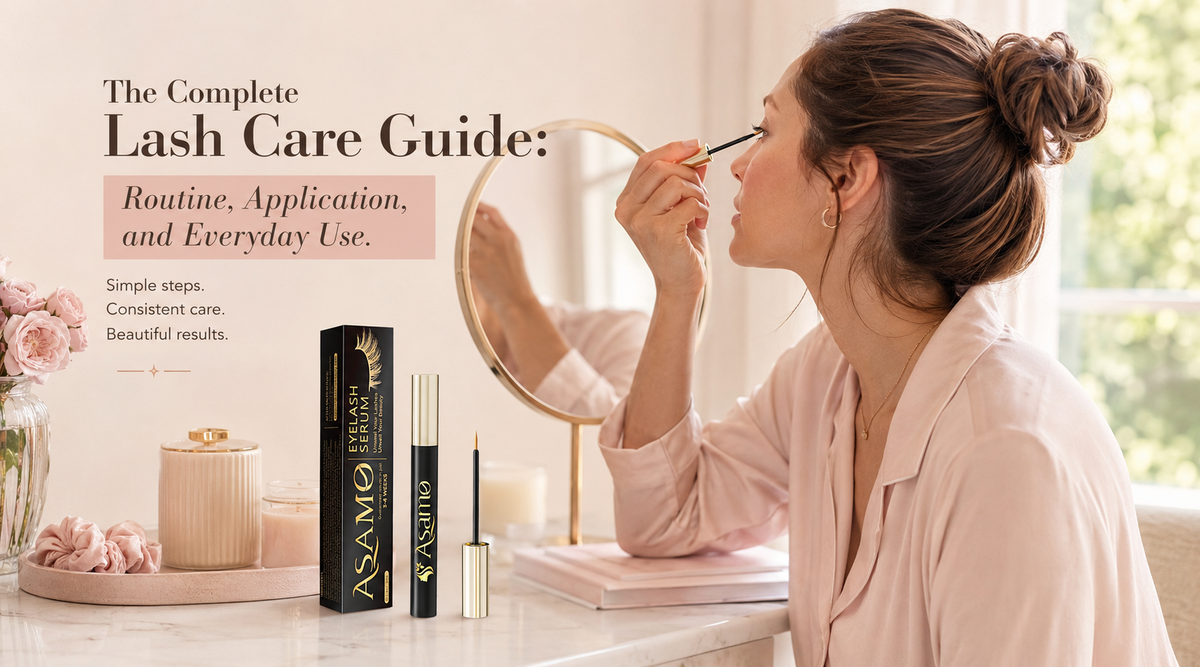
“Botanical lash serum ingredients” is a practical search topic because ingredient names can sound reassuring, impressive, or familiar—especially when they come from plants. But one botanical extract name cannot tell you the full story about a lash serum.
A single ingredient does not reveal the complete formula, concentration, stability, applicator design, intended application area, or finished-product performance. To understand a botanical lash serum, read the full INCI list together with the product label, packaging, directions, warnings, and any brand evidence supporting specific claims.
This guide focuses on everyday cosmetic use, ingredient-label reading, texture, routine order, hygiene, and label-led decisions. It does not diagnose conditions or promise treatment, permanent change, or results within a fixed time. Any ASAMO product-specific statement should match the final formula, packaging, directions, and finished-product documentation.
Quick Answer: What Do Botanical Extracts in Lash Serum Mean?
Botanical extracts are ingredients derived from plants. Their presence on a lash serum label can tell you that a plant-derived material is included in the formula, but it does not tell you the exact concentration, extraction method, formula stability, compatibility with your routine, or finished-product performance.
Do not assume that a botanical ingredient is automatically gentler, safer, stronger, or more effective because it comes from a plant.
A more useful approach is to consider:
-
The full ingredient list
-
The intended application area
-
The current product label
-
Directions and warnings
-
Applicator and packaging design
-
Product texture
-
Your comfort with the routine
-
Product-specific evidence for any claim
The FDA notes that an ingredient’s source does not determine its safety; plants can contain substances that may be toxic or allergenic. Read the FDA’s guidance on organic cosmetics.
What Is a Botanical Extract?
A botanical extract is a material obtained from a plant or part of a plant. It may come from leaves, flowers, roots, seeds, fruit, bark, algae, or other plant sources.
On a cosmetic ingredient list, botanical ingredients may appear under scientific or Latin-style names. The name can include the plant genus and species, followed by terms such as:
-
Extract
-
Leaf extract
-
Root extract
-
Flower extract
-
Fruit extract
-
Seed extract
-
Water
-
Oil
-
Juice
-
Ferment
-
Callus culture extract
The wording can describe the ingredient source, but it does not explain the entire formula.
For example, an ingredient name usually does not tell you:
-
The exact amount used
-
How the extract was processed
-
Whether it is combined with other ingredients
-
How stable it remains in the finished formula
-
How it behaves with the other formula components
-
What result it produces in a finished cosmetic product
That is why it is better to read the whole product, not just one highlighted ingredient.
“Botanical” Does Not Automatically Mean Better
Plant-based language can make a formula sound simple or gentle. However, “botanical,” “natural,” and “organic” are not automatic proof that a product is safer or better suited to everyone.
The FDA explains that ingredients from plants, including organically grown plants, may contain substances that are toxic or allergenic. Read the FDA’s guidance on organic cosmetics.
For consumers, the practical lesson is simple:
-
Do not assume plant-derived means irritation-free.
-
Do not assume synthetic means unsuitable.
-
Do not rank formulas by how many botanical ingredients they contain.
-
Do not use a botanical claim as a substitute for reading directions and warnings.
-
Do not treat an attractive plant image as finished-product evidence.
The right product is one that is appropriately labeled, used in its intended area, and fits comfortably into your routine.
Read the Full INCI List, Not Just the Front Label
Front-label ingredient stories are often designed to help shoppers notice a product. The full ingredient list gives a broader view of the formula.
For cosmetics sold to consumers in the United States, ingredients are generally listed in descending order of predominance, although ingredients at one percent or less may be listed without regard to that order. Read the FDA’s cosmetic labeling requirements.
This still does not reveal exact percentages or finished-product performance. But it can help you see that a formula contains more than one highlighted botanical ingredient.
When reading a lash serum label, consider:
-
Which ingredients are listed
-
Whether you recognize any personal preferences or ingredients you avoid
-
Whether the product is intended for use near the eyes
-
Whether the label includes clear directions and warnings
-
Whether the applicator supports controlled use
-
Whether the product’s claims are specific and supported
A botanical extract is one part of a formula—not the whole formula.
Ingredient Position Is Not a Performance Score
Consumers sometimes try to judge an ingredient by where it appears in the INCI list.
Ingredient order can offer limited context, but it should not be treated as a performance ranking. It does not tell you the quality of the raw material, extraction method, formula stability, interactions with other ingredients, or how the finished product performs.
It also does not prove:
-
That one formula is stronger than another
-
That a higher-listed botanical creates a better result
-
That a lower-listed ingredient is irrelevant
-
That the finished product will work the same way for every person
-
That the formula is more suitable for the eye area
Use ingredient order as one piece of information, not as the entire decision.
Botanical Ingredients and Product Claims Are Different Things
A botanical ingredient can be part of a cosmetic formula without proving that the finished product creates a specific result.
For example, a plant extract name should not automatically be used to support claims that a product treats a medical condition, permanently changes the lashes, repairs tissue, or guarantees a result within a fixed time.
It helps to separate four different questions:
-
What ingredient is included?
The INCI list can help answer this. -
What is the product intended for?
The product label and directions should answer this. -
What does the product feel like in a routine?
Personal use may help answer this. -
What evidence supports a specific product claim?
This requires finished-product support appropriate to the claim.
A botanical ingredient name alone cannot answer all four questions.
Texture Matters More Than a Plant Name for Routine Order
Botanical ingredients do not determine routine order by themselves.
A lash serum’s texture, label directions, applicator, and intended application area are more useful for deciding whether it fits in a morning or evening routine.
If the product label allows morning use, a simple routine may look like this:
Cleanse or refresh as needed → Apply lash serum according to the label → Let it settle → Continue with skincare as appropriate → Apply sunscreen according to its own directions → Apply makeup gently.
If the label permits or directs evening use, a practical routine may be:
Remove eye makeup gently → Cleanse → Wash hands → Apply lash serum according to the label → Let it settle → Store cleanly.
Do not change placement, amount, or frequency because a product contains botanical extracts.
Use a Small Controlled Amount
A botanical formula should still be applied according to its label.
Use only the small amount directed by the product. Excess product can stay visibly wet, move outside the intended area, transfer to nearby skin, interfere with makeup, or make the routine feel heavier.
There is no universal number of drops or brush strokes that works for every product. Fine brushes, wands, tubes, and other applicators can release different amounts.
A controlled amount should:
-
Stay in the intended area
-
Avoid pooling or dripping
-
Settle before the next step
-
Feel manageable in your routine
-
Match the product label directions
More product does not make a botanical ingredient more useful.
Do Not Treat Discomfort as a Natural “Adjustment”
“Natural” and “botanical” do not mean that discomfort should be ignored.
If you experience persistent burning, stinging, noticeable redness, swelling, eye symptoms, or another concerning reaction, stop using the product. Do not assume discomfort is proof that a botanical ingredient is active or that the product is working.
The FDA advises consumers to stop using eye cosmetics if irritation occurs and to see a doctor if irritation persists. Read the FDA’s Eye Cosmetic Safety guidance.
If a product is new to you and its label allows it, a cautious external skin test may help identify an obvious reaction before regular use. However, do not patch test lash serum on the eyelid, lash line, inner waterline, or in the eye.
Introduce One New Product at a Time
If you start a new botanical lash serum while also changing your eye cream, mascara, makeup remover, cleanser, and sunscreen, it becomes difficult to understand what is affecting your routine.
Keep the surrounding products familiar at first. Notice practical details such as:
-
Does the serum settle comfortably?
-
Does it remain in the intended area?
-
Does makeup apply normally afterward?
-
Does the product move, pill, or transfer?
-
Does the area feel comfortable?
-
Is the applicator easy to keep clean?
Changing one variable at a time is more useful than changing every step in search of a perfect botanical routine.

Keep the Applicator Clean
Botanical ingredients do not change the basic hygiene rules for eye-area cosmetics.
Wash and dry your hands before opening lash serum. Keep the applicator away from mascara, makeup residue, fingers, countertops, towels, and other unclean surfaces. Close the product promptly after use and do not share it.
The FDA advises consumers to wash hands before applying eye cosmetics, keep applicators clean, and avoid sharing eye-area products. Read the FDA’s Eye Cosmetic Safety guidance.
Do not add water, saliva, makeup remover, alcohol, or another cosmetic product into the packaging. If the formula develops an unusual smell, color, texture, or damaged packaging, stop using it if it appears abnormal and review the label.
Store Botanical Lash Serum Simply
Unless the product label says otherwise, store lash serum in a cool, dry place away from direct sunlight and prolonged heat.
Avoid leaving it:
-
In a hot car
-
On a sunny windowsill
-
Open beside a sink
-
Near shower steam
-
Against damp towels
-
Beside a heat vent
Do not assume that a botanical or plant-based formula should be stored differently unless the product label provides specific instructions.
Keep the product in its original packaging whenever possible. This preserves directions, warnings, ingredient information, and batch details.
How to Include ASAMO Botanical Lash Care in Your Routine
ASAMO lash care can be presented as a label-led cosmetic routine. Any botanical extracts in a final ASAMO formula should be discussed as ingredients within the complete finished product—not as stand-alone proof of a specific result.
Start with clean, dry hands. Read the current ASAMO ingredient list, directions, and warnings. Apply ASAMO lash serum only in the intended area and according to the product label. Use a small controlled amount, let it settle, and keep the applicator clean.
Morning, if allowed: Clean Hands → Read the Label → Apply ASAMO Lash Serum as Directed → Let It Settle → Continue With Sunscreen and Makeup.
Evening, if allowed or directed: Remove Makeup Gently → Cleanse → Clean Hands → Apply ASAMO Lash Serum as Directed → Store Cleanly.

Frequently Asked Questions
What does “botanical” mean in lash serum?
It generally means the formula includes one or more ingredients derived from plants. It does not tell you the exact amount, stability, complete formula design, or finished-product performance.
Are botanical lash serum ingredients safer?
Not automatically. The FDA notes that an ingredient’s source does not determine its safety, and some plants can contain substances that are toxic or allergenic.
Does a botanical extract make lash serum more effective?
A single botanical ingredient name does not prove that a finished lash serum is more effective. Product-specific claims need support appropriate to the specific finished formula and claim.
How can I read botanical ingredients on an INCI list?
Look for scientific plant names and terms such as extract, leaf extract, flower extract, root extract, seed extract, oil, water, juice, or ferment. Then read the rest of the formula, product directions, warnings, and packaging information.
Does a botanical ingredient listed first mean it is the best ingredient?
No. Ingredient order offers limited context but does not prove quality, formula stability, or finished-product performance.
Can I use more lash serum if it contains botanical extracts?
No. Use only the amount directed by the product label. More product may move, transfer, feel heavy, or interfere with nearby skincare and makeup.
What if a botanical lash serum stings or causes redness?
Stop using it. Do not treat stinging, burning, redness, swelling, or eye symptoms as proof that the product is working. Seek appropriate professional guidance if symptoms are persistent, severe, or concerning.
Should I patch test a botanical lash serum?
A patch test may help identify an obvious skin reaction before regular use, but it does not guarantee future comfort. Follow the product label first and do not patch test on the eyelid, lash line, inner waterline, or eye.

Final Thoughts
Botanical extracts can be part of a lash serum formula, but they should be understood in context.
Read the full INCI list, product directions, warnings, packaging, and brand evidence rather than relying on one plant ingredient or a “natural” message. Use the product only in its intended area, start with a small controlled amount, and stop use if you experience persistent or concerning discomfort.
Share:
Should You Patch Test a Lash Care Product?
Peptides in Lash Serum: A Label-Reading Guide