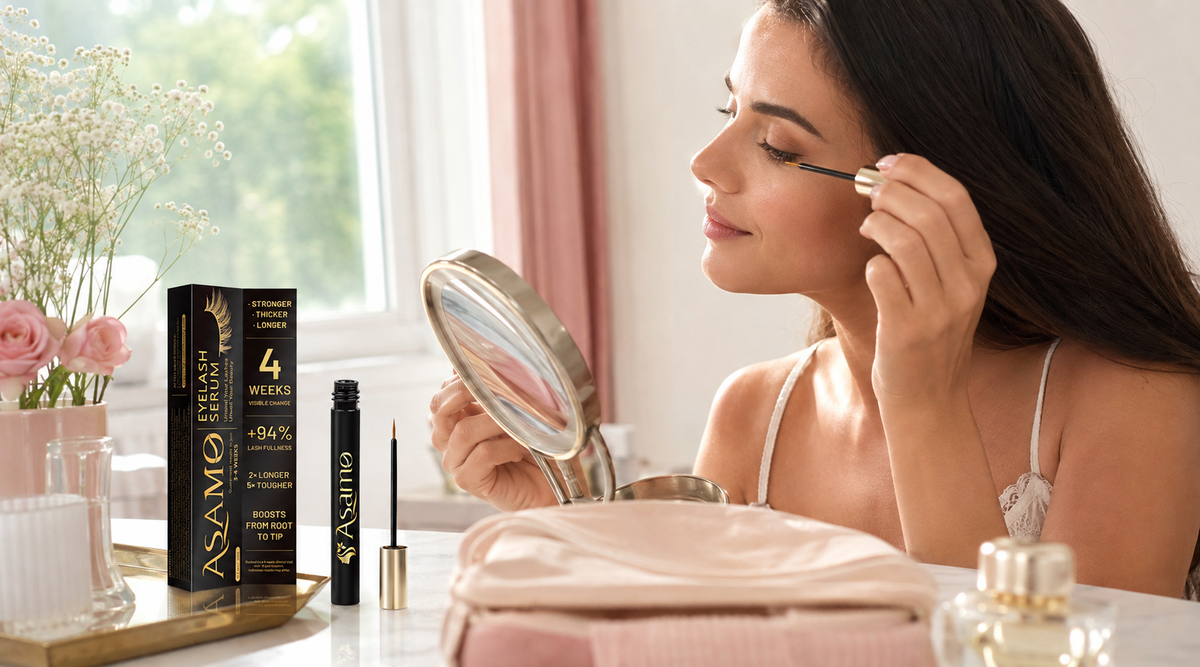
“Peptides in lash serum” is a practical search topic. Most people are not only looking for a definition—they want to know what peptides mean on an ingredient list, whether a peptide-based lash serum fits their routine, where to apply it, how much to use, and whether it can work alongside makeup.
The short answer: a peptide is an ingredient category, not a guarantee of a finished product’s performance. One ingredient name cannot tell you the full formula, concentration, stability, compatibility with the eye area, or final cosmetic result. Read the INCI list together with the product label, directions, packaging, and brand-specific evidence.
This article focuses on everyday cosmetic use, texture, layering, comfort, hygiene, and label reading. It does not diagnose conditions or promise treatment, permanent change, or a fixed timeline for results. Any ASAMO product-specific statement should be updated only after the final formula, directions, packaging, and finished-product testing are confirmed.
Quick Answer
Peptides are short chains of amino acids used in many cosmetic formulas. Seeing a peptide on a lash serum’s INCI list does not, by itself, establish the amount in the formula, how stable it is, how it is delivered, or what the finished product will do.
The most useful approach is simple:
-
Use the serum only on the external area stated on its label.
-
Follow the label’s frequency, amount, and warnings.
-
Introduce one new product or variable at a time.
-
Treat comfort, texture, and makeup compatibility as practical observations—not proof of a specific biological effect.
-
Stop use if you experience persistent burning, clear swelling, significant redness, eye symptoms, or another concerning reaction.
What Does “Peptide” Mean in a Lash Serum?
In cosmetic ingredient language, “peptide” describes a type of ingredient made from linked amino acids. Different peptides have different names, structures, and roles within a formula. You may see names such as oligopeptide, polypeptide, acetyl tetrapeptide, or a proprietary-looking peptide name on an INCI list.
That label detail can be useful, but it has limits.
A peptide name does not tell you:
-
Its exact percentage in the formula
-
Whether it is present at a level relevant to a particular claim
-
How it performs alongside the rest of the formula
-
How the product feels, dries, or layers
-
Whether the finished serum is suitable for your individual routine
-
Whether a specific cosmetic claim has been substantiated for that finished product
For products sold to consumers in the United States, cosmetic ingredients generally appear in descending order of predominance, although ingredients at one percent or less may be listed in any order. That means ingredient order is helpful context, but it is not a precise concentration chart. FDA’s cosmetic labeling guidance explains these rules in more detail.
Read the Complete Formula, Not a Single Featured Ingredient
“Contains peptides” is not the same as a complete product evaluation. A lash serum is a finished formula: water or other base ingredients, humectants, film-formers, preservatives, conditioning ingredients, botanical extracts, peptides, packaging, and an applicator can all affect the daily experience.
When comparing peptide lash serums, look at the full picture:
| What to review | Why it matters |
|---|---|
| Product directions | Confirms the intended application area, frequency, and precautions |
| Full INCI list | Helps identify ingredients you prefer or need to avoid |
| Texture | Affects spread, dry-down, and makeup compatibility |
| Applicator | Changes how much product is picked up and where it can be placed |
| Packaging | Influences hygiene, storage, and accidental over-application |
| Finished-product evidence | Supports any product-specific cosmetic statements more directly than a single ingredient name |
A long ingredient list is not automatically better, and a short ingredient list is not automatically gentler. Formula quality cannot be judged by peptide count, botanical count, price, or trend value alone.
Start With the Label
The label is the most practical starting point for any lash serum—peptide-based or otherwise. It should guide where the product belongs, how often to use it, how much to apply, and when to stop.
Do not assume that every lash serum should be used in the same place or in the same way. The product category and the brush shape do not replace the instructions for that exact product.
For eye-area cosmetics, ingredient declarations and clear directions matter. The FDA also emphasizes clean use, avoiding product sharing, and paying attention to contamination risk around the eyes. Read the FDA’s eye cosmetic safety guidance.
Use the Smallest Suitable Amount
More product is not necessarily more useful. With a lash serum, excess product may create a wet layer that moves, transfers, takes longer to settle, or interferes with the next step.
There is no universal number of drops or strokes because applicators differ. A fine brush, felt tip, spoolie, tube, pump, and dropper can all dispense very different amounts.
Start with the smallest label-directed amount that can be applied neatly to the intended external area. If product pools, drips, feels overly wet, or repeatedly transfers into nearby skincare or makeup, reduce the amount before changing multiple other steps.
Apply Gently and Only Where Directed
The eye area is delicate. Avoid pulling the skin, pressing hard at the lash line, or repeatedly going back over the same area.
Use clean hands and a clean applicator. Apply only to the external location explicitly permitted by the product label. Do not intentionally apply cosmetic lash serum to the eye itself or the inner waterline unless the product’s directions clearly state otherwise.
Burning, stinging, or obvious redness should not be interpreted as evidence that a peptide product is “working.” If discomfort persists, stop using the product, follow the label’s instructions, and seek appropriate professional guidance—especially when symptoms involve the eye.
Morning or Night: Let the Product and Routine Decide
There is no one fixed morning-or-night rule for every peptide lash serum.
A morning routine may work if the label allows it and the texture settles comfortably before sunscreen or makeup. Keep the routine light, use a controlled amount, and wait until the serum is no longer visibly wet or mobile before applying the next product.
An evening routine can be easier for people who wear mascara daily because there is no makeup layering to manage. After removing eye makeup gently and allowing the intended area to dry, apply the serum according to its label.
If a product is labeled for evening use only, follow that instruction even if its texture seems compatible with a morning routine.
You Do Not Need to Count Exact Drying Minutes
Different formulas settle at different speeds. There is no universal wait time that applies to every peptide serum, climate, amount, or makeup routine.
Instead of counting minutes, wait until the product is no longer obviously wet, running, or likely to mix into the next layer. Temperature, humidity, application amount, and the texture of the next product can all change that timing.
If you must wait an unusually long time to avoid transfer or pilling, try using less product or simplifying nearby steps. Adding more product is unlikely to solve a dry-down problem.
Can You Use a Peptide Lash Serum With Mascara?
Possibly—if the product label allows morning use and the serum settles comfortably before makeup. The order should be based on the exact formula and directions, not on the word “peptide.”
A practical way to test compatibility:
-
Keep your familiar makeup routine the same.
-
Use only the label-directed amount of serum.
-
Let it settle until it is no longer visibly wet.
-
Apply mascara gently.
-
Observe whether mascara skips, flakes, transfers, or feels heavier than usual.
Change only one variable at a time. If makeup performance becomes unreliable, reduce the serum amount, allow more settling time, move the serum to the evening, or follow the product label’s preferred schedule.

Keep Hygiene Simple
Peptides do not change the basic hygiene rules for eye-area cosmetics.
-
Wash and dry your hands before use.
-
Keep the applicator and opening clean.
-
Close the product promptly after each use.
-
Do not share it with anyone.
-
Avoid touching the applicator to unclean surfaces.
-
Do not add water, saliva, mascara, or another cosmetic into the container.
-
Do not use the product if its smell, color, or texture changes unusually.
The FDA notes that improper handling of eye cosmetics can allow bacteria or fungi to grow in a product, which can raise the risk of eye-area problems. FDA eye cosmetic safety guidance provides general precautions for keeping eye cosmetics clean.
Store It According to the Label
Unless the label says otherwise, many cosmetics are best stored in a cool, dry location away from direct sunlight and sustained heat. A bathroom may be convenient, but frequent heat and humidity changes can make it less ideal for long-term storage.
Keep the original container and label whenever possible. Moving a serum into an unmarked container can separate the product from important directions, warnings, batch information, and ingredient details.
Separate Product Feel From Product Claims
A peptide lash serum may feel silky, lightweight, conditioning, or comfortable. Those are useful cosmetic qualities because they influence whether the product fits into a daily routine.
They are not automatically proof of a particular biological or permanent result.
For accurate content and shopping decisions, keep three levels separate:
-
What the label clearly says
Application area, frequency, warnings, and cosmetic positioning. -
What the user can directly observe
Texture, dry-down, packaging, ease of use, makeup compatibility, and comfort. -
What requires product-specific evidence
Objective performance claims, timelines, or claims that go beyond ordinary cosmetic appearance and care.
This distinction also helps brands avoid presenting general peptide information as proof that one specific finished serum will perform in the same way.
How to Include ASAMO in a Lash Care Routine
ASAMO can use this topic as an educational entry point rather than a page that promises results. Help readers understand how to evaluate a peptide ingredient list, then direct them to the final product label and collection page once those pages are live.
A simple routine framework could look like this:
Morning, if the label allows:
Clean hands → label-directed lash serum application → wait until settled → sunscreen and eye makeup as directed by their own labels
Evening:
Gently remove eye makeup → cleanse → dry the intended application area → label-directed lash serum application → leave the routine simple
The exact ASAMO steps, ingredient discussion, product imagery, and claims should be reviewed against the current formula, packaging, safety information, and finished-product support before publication.

【Alt Text:A simple routine diagram showing clean hands, a small amount of lash serum, settling time, and the next beauty step.】
When to Stop Using a Lash Serum
Stop using the product if the label directs you to do so or if you experience persistent burning, noticeable swelling, significant redness, eye symptoms, or another concerning reaction.
Do not continue because social media content suggests discomfort is expected. When symptoms are severe, persistent, or involve the eye, seek timely advice from an appropriate healthcare professional.
Frequently Asked Questions
What are peptides in lash serum?
Peptides are short chains of amino acids used in many cosmetic formulas. Their presence on an ingredient list does not, by itself, prove a serum’s concentration, stability, suitability, or finished-product performance.
Does a peptide high on the ingredient list mean the serum is better?
Not necessarily. Ingredient order offers some context, but it does not tell you the full formula quality, stability, packaging performance, or whether the product is right for your routine.
Can I use peptide lash serum every day?
Follow the exact product label. Frequency depends on the specific formula, intended application area, and product directions—not on the fact that it contains peptides.
Can I wear mascara after peptide lash serum?
If the product label allows morning use, apply a controlled amount and wait until it is no longer visibly wet before mascara. Test makeup compatibility by changing one routine variable at a time.
Should a peptide lash serum sting?
No. Stinging or burning is not proof that the product is effective. Stop use if discomfort persists or if you notice significant redness, swelling, eye symptoms, or another concerning reaction.
How should I choose a peptide lash serum?
Start with a clear label, the correct intended application area, a manageable texture, hygienic packaging, and claims that match available finished-product evidence. Do not choose based on a peptide name alone.

Final Takeaway
Peptides can be one part of a lash serum formula, but a peptide name alone cannot tell you everything about the product. Consider the complete INCI list, label directions, intended application area, texture, packaging, routine compatibility, and available finished-product evidence together.
Keep the routine simple, use only the label-directed amount, and change one variable at a time. If you experience persistent or concerning discomfort, stop using the product.
Share:
Botanical Extracts in Lash Serum: How to Read the Label
The Complete Lash Care Guide: Routine, Application, and Everyday Use