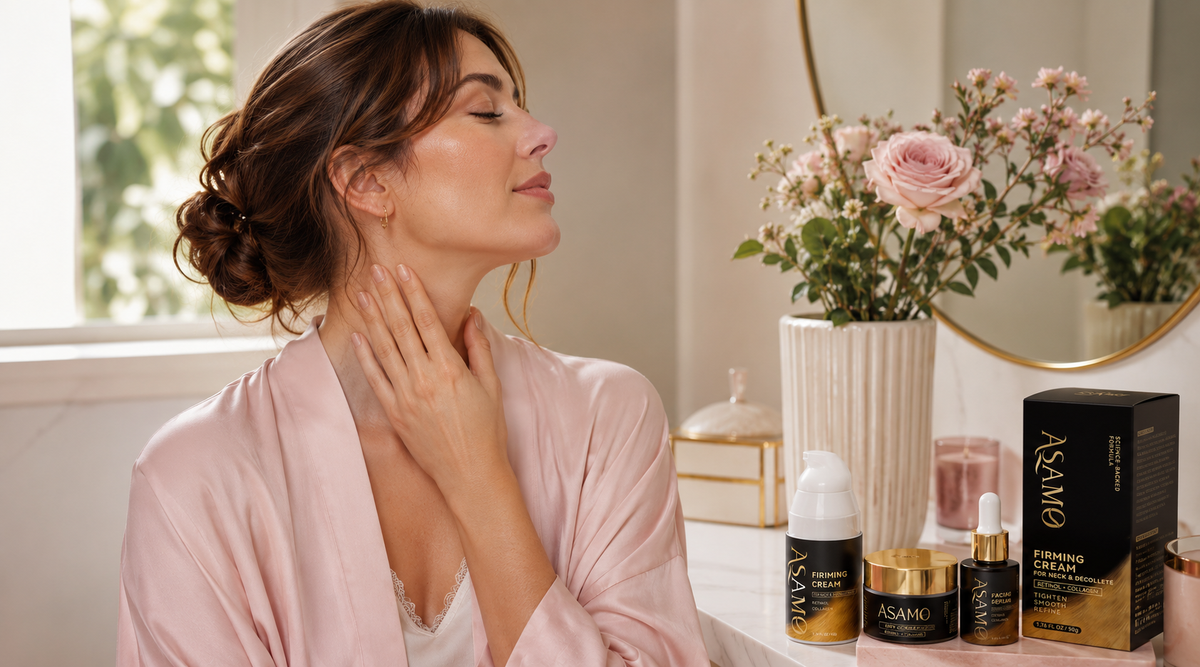
“Too many skincare products” is a common concern because a routine can quickly become crowded. A cleanser, toner, serum, moisturizer, eye product, sunscreen, makeup base, and several new products may each seem reasonable on their own—but together, they can become difficult to use, difficult to evaluate, and difficult to maintain.
The short answer: using more skincare products does not automatically create a better routine. Common problems often come from excess amount, repeated product functions, insufficient settling time, friction, or ignoring product directions—not because a product is “working harder.”
This guide focuses on everyday cosmetic use, product texture, layering, comfort, hygiene, and label reading. It does not diagnose skin conditions or promise treatment, permanent change, or fixed results. Any ASAMO product-specific wording should be updated only after the final formula, packaging, directions, and finished-product testing are confirmed.
Quick Answer
A routine becomes “too much” when it has more layers than you can use comfortably or understand clearly. Products may overlap in purpose, feel heavy together, pill under sunscreen or makeup, or make it difficult to identify what caused a change in comfort.
A better routine is not necessarily the shortest possible one. It is one where every product has a clear reason for being there, follows its label directions, and works comfortably with the steps around it.
If your routine feels crowded, start by simplifying rather than adding another product to fix the problem.
More Products Do Not Automatically Mean Better Skincare
Skincare is often presented as a long sequence of categories. That can make it seem as though every routine needs multiple serums, layered moisturizers, specialized products, and separate morning and evening versions.
In reality, a useful routine is based on purpose, not product count.
Ask these questions about each product:
-
What is this product’s role in my current routine?
-
Is its intended area of use clear from the label?
-
Does it overlap with another product I already use?
-
Does it layer comfortably before or after the next step?
-
Is it practical for my morning or evening schedule?
-
Can I tell whether it is contributing to comfort or discomfort?
If you cannot answer what a product is doing in the routine, it may be a good candidate to pause while you reassess.
Signs Your Routine May Be Overcrowded
Having several products does not automatically create a problem. The issue is whether the routine remains comfortable, clear, and easy to repeat.
| What you notice | What it may suggest |
|---|---|
| Your skin feels heavy or coated after application | There may be too much product or too many rich layers. |
| Products pill into flakes or little rolls | Texture, amount, friction, or overlapping films may be causing conflict. |
| Makeup moves, separates, or does not apply smoothly | The skincare layers underneath may be too numerous or too rich. |
| You keep adding products but cannot tell what changed | Too many new variables are being introduced at once. |
| You need a long wait between every step | The amount or number of layers may be impractical. |
| You do not know which products are safe for which areas | The routine needs a label review. |
| You feel persistent discomfort after adding products | Stop use and reassess rather than continuing to layer. |
A routine should help you make decisions more easily, not create a daily experiment with too many unknowns.
Begin With the Product Label
The most useful starting point is the product label. It can explain intended area of use, suggested frequency, warnings, storage guidance, and whether the product has directions for daytime or nighttime use.
Category names alone are not enough. A “serum” can be fluid, gel-like, creamy, or rich. A “cream” can be light or substantial. Two products marketed for similar purposes may not be designed to be used together.
When general skincare advice conflicts with the instructions for a specific product, follow the label. The American Academy of Dermatology also provides general guidance on applying skincare in an appropriate order, but product instructions remain the more specific reference. Read the AAD’s overview of skincare application order.
Build Around Clear Roles, Not Product Categories
You do not need to use every category that appears in skincare content. A practical routine can include only the steps that make sense for you.
| Product role | Possible purpose in a routine | Questions to ask |
|---|---|---|
| Cleanser | Cleanses the intended area | Does it fit your routine and label directions? |
| Lightweight leave-on product | Adds one chosen step after cleansing | Is there already another product serving a similar role? |
| Moisturizer | Adds a more substantial layer if desired | Does it layer comfortably with the product underneath? |
| Eye-area product | Used only where the label allows | Is it intended for that specific area? |
| Sunscreen | Daytime use according to its own directions | Does the skincare underneath allow it to apply evenly? |
This is not a checklist that every person must complete. It is a way to identify whether two or more products are doing the same job without adding enough practical value.
Use the Smallest Appropriate Amount
Too much product can make even a short routine feel crowded. Excess product may remain on the surface, slide around, transfer to clothing, make makeup move, or form visible flakes when touched.
There is no universal number of pumps, drops, or fingertip amounts because packaging varies. Start with the smallest label-appropriate amount that can spread evenly over the intended area.
If you use several products, small amounts become even more important. A reasonable amount from one product can become excessive when it is layered over three or four others.
A useful way to test your routine is to keep the same products but reduce the amount of one step. If the routine feels lighter or pills less, you have learned something practical without replacing everything.
Texture Changes How Products Work Together
Liquid, gel, lotion, cream, balm, and oil-like textures can behave differently in a routine. A product that feels comfortable on its own may not layer well with every other formula.
| Texture | How it may behave | Routine consideration |
|---|---|---|
| Fluid | Spreads quickly and may feel light | Use sparingly to avoid pooling or slipping. |
| Gel | Can form a smooth surface layer | Repeated rubbing may cause rolling or pilling. |
| Lotion | Often works as a middle layer | Test whether another similar layer is necessary. |
| Cream | May feel more substantial | Consider reducing layers before or after it. |
| Balm-like texture | Can leave a noticeable finish | Follow label directions before applying other products over it. |
“Lighter to richer” can be a useful starting point, but it is not an absolute rule. Product labels and actual texture should guide the order.
Introduce One New Product at a Time
Adding several new products at once makes it difficult to know what changed. If the routine starts to pill, feel uncomfortable, or interfere with makeup, you will not know which product or combination caused it.
A more useful approach is to introduce one new product while keeping the rest of the routine familiar. Observe:
-
Whether it spreads evenly
-
Whether it changes the feel of the next product
-
Whether makeup, sunscreen, or clothing contact becomes less comfortable
-
Whether pilling appears
-
Whether you notice persistent discomfort
If you make several changes at once, you may have to restart the entire routine to understand what happened. One change at a time gives you a clearer answer.
Gentle Application Matters
More rubbing does not make a product work better. In fact, repeated rubbing is one of the most common reasons a multi-step routine begins to pill.
Use clean hands. Place a small amount of product where it is intended to go, then spread it gently with light, controlled movements. Stop once it has been distributed evenly.
Avoid pulling at delicate areas, including the eye area, neck, and skin near the lash line. Use products only where their labels allow, and keep products out of the eyes.
Do not interpret burning, stinging, or marked redness as proof that a product is “active.” If discomfort persists, stop use, follow the label, and seek professional guidance as appropriate.
You Do Not Need to Set a Timer Between Every Layer
There is no fixed number of minutes that works for every skincare formula. How long a product takes to settle can change with texture, amount, temperature, humidity, and the product applied next.
A practical guide is to continue when the previous layer is evenly spread and no longer feels obviously wet, runny, or likely to move around.
If you need to wait a long time between products to avoid pilling, do not assume waiting longer is the only answer. Try one of these first:
-
Use less of the first product.
-
Remove a duplicate layer.
-
Apply with less friction.
-
Move a richer texture to the evening if its label allows.
-
Test whether the next product is necessary in the same routine.
How to Simplify a Crowded Routine
You do not need to discard everything at once. Simplify in a way that lets you observe what is actually helpful.
A simple morning version
-
Cleanse or follow your usual morning cleansing approach.
-
Use one label-appropriate leave-on product if needed.
-
Add moisturizer only if it fits comfortably.
-
Apply sunscreen according to its own label instructions.
A simple evening version
-
Cleanse gently.
-
Use one leave-on product with clear label directions.
-
Add a moisturizer or richer texture if desired and comfortable.
This approach does not imply that every product should be used morning and night. Product labels, texture, and personal comfort should determine where a product fits.
When Products Overlap
A routine may be crowded when multiple products are trying to provide a similar experience without a clear reason to use all of them together.
For example, two rich leave-on layers may feel fine individually but too heavy when used one after another. Several products may also contain overlapping featured ingredients, but ingredient names alone do not reveal concentrations, formula design, or finished-product performance.
Instead of asking, “Can I use all of these?” ask:
-
Which product is the easiest to use consistently?
-
Which one creates the most comfortable finish?
-
Which one has clear label directions for the area I am using it on?
-
Does one product make another step unnecessary?
-
Can I tell why each product is still in the routine?
A shorter routine with clear roles is often easier to adjust than a long routine built around product categories.
Pilling Is Usually a Routine Signal
Pilling occurs when products roll into small flakes or soft bits on the skin. It is often linked to too much product, texture incompatibility, repeated rubbing, or layers that have not had enough time to settle.
It is not proof that a product is working, activating, or penetrating more deeply.
| If this happens | Test this adjustment |
|---|---|
| Skincare pills before sunscreen | Reduce the amount or number of leave-on layers. |
| Pilling starts after moisturizer | Test whether a smaller amount or one less layer improves comfort. |
| Makeup pills over skincare | Keep the morning routine lighter and reduce pressure from tools. |
| Pilling appears around the neck or jawline | Use less near collars, hair, scarves, or other friction points. |
| The problem began after a new product | Pause it or test it in a simpler routine. |
| You cannot identify the cause | Return to a basic routine, then add one product back at a time. |
Do not change every part of your routine at once. Controlled changes make troubleshooting much easier.

Morning Routines Need to Work With Sunscreen and Makeup
Morning skincare needs to work with real daily conditions: sunscreen, makeup, clothing, weather, travel, and limited time.
If your routine feels too heavy in the morning, consider keeping richer textures for the evening if the label allows. You may not need several leave-on products before sunscreen and makeup.
Sunscreen should always be used according to its own product label, including directions for amount, coverage, and reapplication. Do not mix sunscreen directly with skincare to reduce layers or alter its texture.
If makeup moves or pills, first reduce the amount of skincare underneath. Then test one adjustment at a time rather than replacing your entire routine.
Evening Routines Can Be Richer—but Still Need a Purpose
Evening can be a more practical time for a richer texture because there may be less makeup and less friction from daytime activity. But nighttime is not a reason to use every product you own.
After cleansing, choose the product or products that have the clearest role in your routine. Use clean hands, follow label directions, and avoid adding multiple unfamiliar products on the same evening.
A brief, stable evening routine can make it easier to notice whether a product feels comfortable and layers appropriately.
Read the Full Formula, Not Just a Featured Ingredient
INCI ingredient lists can help consumers identify ingredients they prefer or want to avoid. But a single ingredient name cannot reveal the exact concentration, formula stability, delivery system, or final performance of a finished product.
When deciding whether a product belongs in your routine, consider the full picture:
-
Intended area of use
-
Directions and warnings
-
Full ingredient list
-
Packaging and dispensing method
-
Texture and finish
-
Compatibility with your existing steps
-
Evidence supporting any specific product claim
Ingredient quantity is not a shortcut to routine quality. A longer ingredient list also does not automatically mean a better product or a more complete routine.
Keep Packaging and Storage Simple
Packaging affects how much product you use. Pumps, tubes, jars, droppers, and applicators can all dispense products differently. Use only what you need and keep openings and applicators clean.
Close products promptly after use and avoid placing applicators on unclean surfaces. Do not add water, saliva, or other cosmetic products to change a formula’s texture. This can affect the product and may increase contamination risk.
Unless the label says otherwise, store cosmetics in a cool, dry place away from direct sunlight and prolonged heat. Do not transfer products to unmarked containers that remove directions, warnings, ingredient information, or batch details.
Reassess Your Routine as Life Changes
Season, travel, makeup habits, and comfort can all change what feels practical. Reassessment does not mean replacing every product.
Start with these questions:
-
Are all products being used in the areas allowed by their labels?
-
Is each product serving a clear function?
-
Are any steps repeated without improving comfort?
-
Is the amount reasonable for the packaging and target area?
-
Does one product make another layer pill, slide, or feel heavy?
-
Would a simpler morning or evening version work better?
A routine can evolve without becoming more complicated.
How ASAMO Can Fit Into a Simpler Routine
ASAMO can use this topic as an educational resource, helping readers understand product roles, textures, label directions, and routine comfort before directing them to a verified collection page.
The goal should be to help consumers make informed choices—not to suggest that they need a complete set of products. Any ASAMO product-specific claim should match the final formula, packaging, directions, and finished-product evidence.

Frequently Asked Questions
How do I know if I am using too many skincare products?
Your routine may be too crowded if it feels heavy, pills, interferes with makeup or sunscreen, takes too long to apply, or makes it difficult to identify which product is causing discomfort.
Is it bad to use several skincare products?
Not necessarily. Several products can be used in the same routine if each has a clear purpose, follows its label, and layers comfortably. The issue is unnecessary repetition or discomfort—not a specific product count.
Should I use all my skincare products every day?
Not automatically. Frequency should follow each product’s label directions and fit your routine. You do not need to use a product just because you own it.
What should I remove first from an overcrowded routine?
Start by pausing one product that overlaps with another step or creates the heaviest finish. Keep the rest of your routine familiar and observe what changes.
Can too many products cause pilling?
Yes. Layering several products can create excess surface film, especially when the products are overapplied or rubbed repeatedly. Reduce the amount or number of layers and test one change at a time.
Can I use different products in the morning and evening?
Yes, if their labels allow it. Morning routines often need to work with sunscreen and makeup, while evening routines may be more suitable for richer textures. There is no single schedule that fits every formula.
When should I stop using a product?
Stop use if you experience persistent burning, marked redness, obvious swelling, eye symptoms, or another concerning reaction. Follow the label and seek professional guidance as appropriate.

The Takeaway
Using too many skincare products does not automatically improve a routine. The best routine is one where each step has a clear purpose, uses a reasonable amount, follows the product label, and fits comfortably with the layers around it.
If your routine feels heavy, pills, or becomes difficult to understand, simplify first. Keep familiar products stable, introduce one new product at a time, and adjust amount, texture, or timing before adding another layer.
ASAMO should update product-specific wording only after the final formula, testing materials, label directions, packaging, and live URLs are confirmed.
Share:
Why Does Skincare Pill and How Can You Reduce It?
How to Introduce One New Skincare Product at a Time