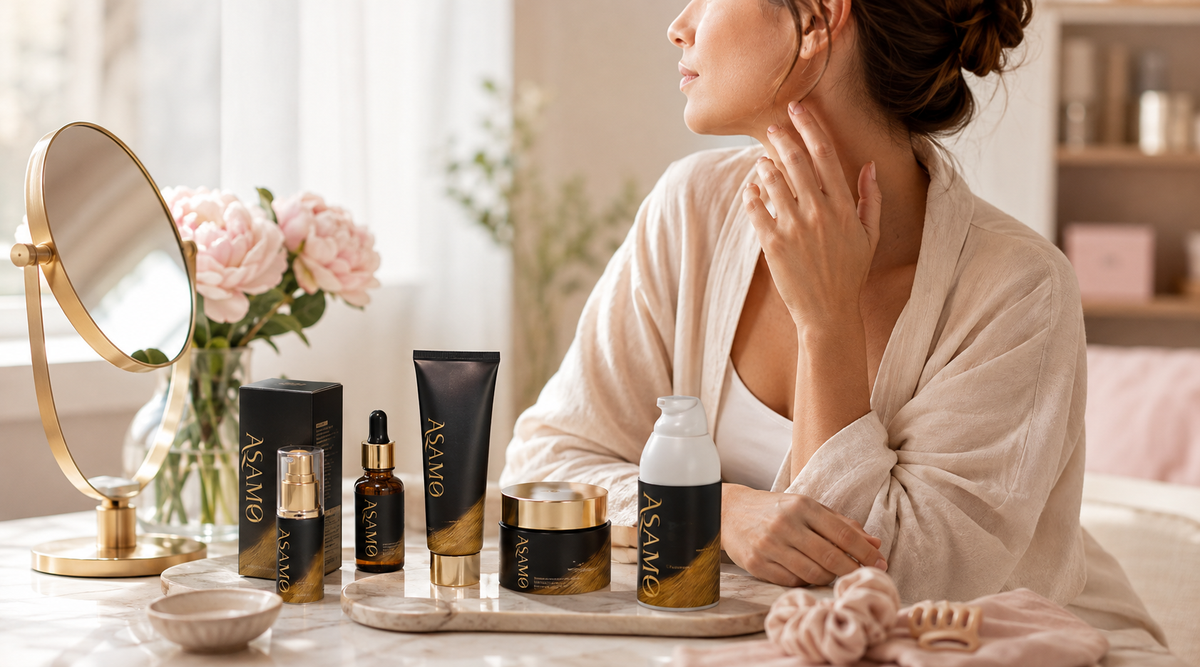
“Why does skincare pill” is a practical question with a practical goal: you want products to apply smoothly, stay comfortable, and work with sunscreen or makeup without rolling into little flakes.
The short answer is that pilling usually comes from too much product, overlapping layers, friction, insufficient settling time, or a mismatch between textures. It is not proof that a product is “working,” and it does not always mean that one product is bad.
This guide covers everyday cosmetic use, product texture, layering, comfort, hygiene, and label reading. It does not diagnose skin conditions or promise treatment, permanent change, or fixed results. Any ASAMO product-specific statement should be updated only after the final formula, packaging, directions, and finished-product testing are confirmed.
Quick Answer
Skincare usually pills because there is too much product on the skin, several layers are competing to form a surface film, or hands and makeup tools are creating too much friction.
Start by using less, applying with lighter movements, and changing only one part of the routine at a time. Let each layer settle until it is no longer obviously wet or moving, but do not assume that every product requires a fixed waiting time.
A comfortable routine is usually a clearer and simpler routine: correct placement, label-appropriate use, reasonable amounts, and products that work well with the steps before and after them.
What Does Skincare Pilling Look Like?
Pilling happens when a product rolls into tiny flakes, beads, or soft “eraser-like” pieces on the skin. It may occur while applying skincare, after sunscreen, or when makeup is added.
It can happen on the face, neck, chest, or around areas where clothing creates friction. Pilling is different from normal texture changes in a product. It is usually most noticeable when rubbing the skin or applying another layer on top.
The first important point: pilling does not prove that an ingredient is activating, penetrating, or delivering a stronger result. It is generally a routine compatibility issue that can often be reduced through small adjustments.
Start With the Product Label
Before changing a routine, check the product label. It can tell you where the product is intended to be used, how often to use it, whether to avoid certain areas, and whether it has specific directions for daytime or nighttime use.
A category name such as “serum,” “cream,” or “primer” does not automatically explain how a product will layer. Two lightweight-looking products can still form different finishes on the skin.
When general advice conflicts with a product’s directions, follow the product label. The American Academy of Dermatology also provides general guidance on applying skincare in an appropriate order, but individual product instructions still matter. Read the AAD’s skincare-order guidance here.
The Most Common Reasons Skincare Pills
Pilling is rarely caused by only one thing. Often, it is the combination of amount, texture, order, and friction.
| Common cause | What may be happening | First adjustment to test |
|---|---|---|
| Too much product | Excess product remains on the surface and rolls when touched. | Use less of one product. |
| Too many layers | Several products create overlapping films. | Remove one nonessential step. |
| Repeated rubbing | Fingers, brushes, or sponges disturb layers that are settling. | Spread or press gently with fewer passes. |
| Layers applied too quickly | The previous product is still wet or moving. | Let it settle until it is no longer obviously wet. |
| Texture mismatch | Two formulas may not layer comfortably together. | Keep one product the same and test a different surrounding step. |
| Sunscreen or makeup interaction | Later products can disturb skincare underneath. | Reduce skincare amount beneath sunscreen or makeup. |
| Clothing or hair friction | Contact at the neck, jawline, or hairline can roll product. | Use a thinner layer near friction points. |
The goal is not to blame one product immediately. Test the routine in a controlled way so you can identify the actual trigger.
Use the Smallest Appropriate Amount
More product does not automatically make a routine better. Overapplication can create slipping, heaviness, transfer to clothing, makeup movement, and pilling.
There is no universal pump, drop, or fingertip amount because packaging varies. A pump from one product can dispense much more than a pump from another. Begin with the smallest label-appropriate amount that can be spread evenly over the intended area.
If pilling happens often, reduce the amount of one product first. Do not reduce every layer at once. If the problem improves, you have a clearer idea of where the excess surface film was coming from.
Apply With Less Friction
Application technique can make a major difference. Many people accidentally create pilling by rubbing a product back and forth long after it has already been distributed.
Try this instead:
-
Dispense a small amount onto clean fingertips.
-
Dot or place it across the intended area.
-
Spread it with light, even movements.
-
Stop once the product is distributed.
-
Allow the layer to settle before touching it again.
You do not need to massage until every trace of texture disappears. More rubbing can disturb the film that the product is forming on the skin.
Use particular care around the eye area, neck, and other delicate or sensitive-feeling areas. Do not tug the skin, and only use products in locations clearly allowed by the label.
You Do Not Need to Time Every Step
There is no fixed wait time that works for every formula. A thin fluid may settle quickly, while a richer cream may remain more noticeable on the surface. Temperature, humidity, amount, and the next product all influence what happens.
Instead of watching the clock, look for practical signs that the previous layer has settled:
-
It is evenly spread.
-
It is no longer visibly running or gathering.
-
It does not feel excessively wet or mobile.
-
Your fingers are less likely to move the layer around.
If you need to wait an unusually long time to prevent pilling, waiting may not be the main solution. Reduce the amount, simplify the routine, or reassess the texture combination.
Texture Can Change How Products Layer
Texture describes how a product spreads, settles, and feels in a routine. It does not independently prove that a product is stronger or more effective.
| Texture type | How it may behave in a routine | Practical consideration |
|---|---|---|
| Fluid | Spreads quickly and can feel light | Use sparingly so it does not run or pool. |
| Gel | Often feels fresh and smooth | Avoid repeated rubbing after it starts to set. |
| Lotion | Can work as a flexible middle layer | Test a small amount before adding richer layers. |
| Cream | Often leaves a more substantial finish | Consider fewer layers before or after it. |
| Balm-like product | May create a noticeable protective finish | Check label instructions before layering other products over it. |
“Lighter to richer” can be a useful starting point, but labels and actual texture should guide the final order.
Simplify Before Replacing Products
When a routine pills, it can be tempting to replace everything. Usually, that makes it harder to identify what caused the issue.
A more useful test is to simplify for several uses:
-
Keep your cleanser the same.
-
Use one leave-on product in a small amount.
-
Add moisturizer only if needed and label-appropriate.
-
In the daytime, apply sunscreen according to its own label.
-
Observe whether pilling still happens.
If the simplified version works smoothly, add back one product at a time. This approach helps you find the combination that creates the problem without wasting products or guessing.
Morning Pilling: Sunscreen and Makeup Can Be Part of the Issue
Morning routines need to work with sunscreen, makeup, commuting, and clothing. That can make a heavy multi-step routine less practical.
If pilling happens after sunscreen or makeup, test these adjustments:
-
Use a smaller amount of skincare underneath.
-
Reduce duplicate hydrating or rich layers.
-
Let the skincare layer settle until it is no longer visibly wet.
-
Apply sunscreen according to its own directions without over-rubbing the skincare beneath it.
-
Use gentler pressure with makeup tools.
-
Keep the rest of the routine unchanged while testing one adjustment.
Sunscreen should follow its own label for use, coverage, and reapplication. Skincare underneath does not replace sunscreen instructions, and sunscreen should not be diluted or mixed directly with other products to make layering feel easier.
Evening Pilling: Keep the Routine Easy to Observe
Evening may be a better time for a richer texture because there is less makeup and daytime activity. But it is still best to avoid introducing several unfamiliar products at once.
After gentle cleansing, use clean hands and apply products only to their intended areas. If pilling occurs, begin by reducing the amount or removing one overlapping layer. Keep the routine stable long enough to observe the change.
A shorter evening routine can be especially helpful when your skin feels uncomfortable or when you are trying to identify a texture conflict.
Pilling Near the Neck, Hairline, or Clothing
Pilling is not limited to the face. It can occur around the jawline, neck, chest, hairline, or anywhere that experiences repeated contact from hair, collars, scarves, bedding, or hands.
For these areas:
-
Use less product near the edge of the application area.
-
Spread the product evenly instead of allowing it to gather in folds or along the hairline.
-
Give the final layer time to settle before putting on close-fitting clothing.
-
Consider whether a richer texture fits better in the evening.
-
Avoid repeatedly touching the area to check whether it has “absorbed.”
Friction can turn a normal surface finish into visible rolling, even when the products initially looked fine.

A Practical Pilling Troubleshooting Plan
Use one controlled change at a time. This makes your observations more useful.
| If this happens | Try this first | Avoid doing this |
|---|---|---|
| Pilling begins during skincare | Reduce the amount of the product underneath. | Adding more product to “smooth it out.” |
| Pilling begins after moisturizer | Test whether the moisturizer is needed over the previous layer. | Replacing multiple products at once. |
| Pilling begins after sunscreen | Keep skincare lighter underneath and use gentle sunscreen application. | Mixing sunscreen with skincare. |
| Pilling begins under makeup | Use fewer morning layers and reduce rubbing with tools. | Applying more base makeup to cover flakes. |
| Pilling happens only around the neck | Use less product where clothing or hair rubs. | Repeatedly touching the area to test it. |
| Pilling appears after introducing a new product | Pause that product or use it alone in a simple routine. | Introducing another unfamiliar product at the same time. |
A product may work comfortably on its own but not with every surrounding product. That is why a controlled test is more helpful than a universal verdict.
Do Not Confuse Sensory Feel With a Proven Claim
A silky finish, cooling sensation, or rich protective feel can make a product enjoyable to use. These are valid descriptions of product experience, but they are not automatic proof of a biological effect.
Cosmetic content can describe texture, finish, moisturizing feel, appearance, and routine compatibility. It should not turn those observations into claims about treating a condition, permanently changing skin structure, or guaranteeing a result.
Likewise, pilling should not be reframed as evidence that a product is working. A comfortable, well-layered routine is a better goal than a routine that creates visible flakes.
Read the Whole Formula, Not Only a Featured Ingredient
An INCI ingredient list can help consumers identify ingredients they prefer or avoid. But it usually cannot show exact percentages, formula stability, delivery method, or how a finished formula will interact with your other products.
When evaluating a product for your routine, consider:
-
Intended area of use
-
Directions and warnings
-
Full ingredient list
-
Packaging and dispensing method
-
Texture and finish
-
Compatibility with the products before and after it
-
Evidence supporting any specific product claim
A single featured ingredient does not predict whether a product will pill, layer well, or feel comfortable in every routine.
Packaging, Hygiene, and Storage Still Matter
Pumps, tubes, jars, droppers, and applicators affect how much product you use. If a dispenser repeatedly releases too much, use a partial pump or take only the amount you need.
Keep product openings and applicators clean, close packages promptly, and avoid letting applicators touch unclean surfaces. Do not add water, saliva, or other cosmetics to alter a product’s texture. Mixing products can affect the formula and increase contamination risk.
Unless the label says otherwise, store cosmetics in a cool, dry location away from direct sunlight and sustained heat. If a product’s smell, color, or texture changes noticeably, do not attempt to correct it by mixing it with another product.
When to Stop Using a Product
Pilling itself is generally a routine issue, but discomfort should be treated separately. Do not interpret persistent stinging, burning, marked redness, or swelling as a sign that a product is effective.
Stop use if a product causes persistent or concerning discomfort. Follow the label, cleanse or rinse as appropriate, and seek professional advice when needed. For eye symptoms, obvious swelling, or severe reactions, seek timely professional help.
How ASAMO Can Use This Topic
ASAMO can use a pilling guide as an educational page that helps readers make routine decisions without promising a specific product result. The article can direct readers toward accurate product labels and, after publication, a verified collection page.
Any ASAMO-specific wording must reflect the final formula, packaging, directions, and finished-product evidence. Do not create blank links or guess future collection URLs.

Frequently Asked Questions
Why does my skincare pill?
Pilling is commonly linked to excess product, too many layers, repeated rubbing, insufficient settling time, texture conflicts, or interaction with sunscreen, makeup, hair, or clothing.
Does pilling mean skincare is working?
No. Pilling is not evidence that a product is activating or delivering a stronger result. It is usually a surface-layering issue.
Should I wait longer between skincare products?
There is no universal wait time. Continue when the previous layer is evenly spread and no longer obviously wet or moving. If long waits are required, try reducing the amount or number of layers.
Can sunscreen make skincare pill?
It can contribute if the products underneath are too heavy, if application involves too much rubbing, or if the textures do not layer comfortably. Follow the sunscreen label and test one adjustment at a time.
Why does my makeup pill over skincare?
The skincare underneath may be too rich, overapplied, or not settled enough for your makeup product. Try fewer layers, less product, and lighter pressure with tools.
What should I do when pilling happens on my neck?
Use less product around areas that touch collars, hair, or scarves. Avoid repeated touching and consider using richer textures in the evening if labels allow.
When should I stop using a product instead of troubleshooting?
Stop use if you experience persistent burning, marked redness, obvious swelling, eye symptoms, or another concerning reaction. Follow the label and seek professional guidance as appropriate.

The Takeaway
Skincare pilling is usually a signal to simplify and adjust, not a sign that you need more product or a much longer routine.
Start with label directions, use the smallest appropriate amount, apply with gentle movements, and let each layer settle naturally. If pilling continues, test one variable at a time: amount, friction, order, texture, or the number of layers. A routine that feels comfortable and works with sunscreen, makeup, and daily life is more useful than one with the most steps.
ASAMO should update product-specific wording only after the final formula, testing materials, label directions, packaging, and live URLs are confirmed.
Share:
How Long Should You Wait Between Skincare Steps?
Are You Using Too Many Skincare Products?