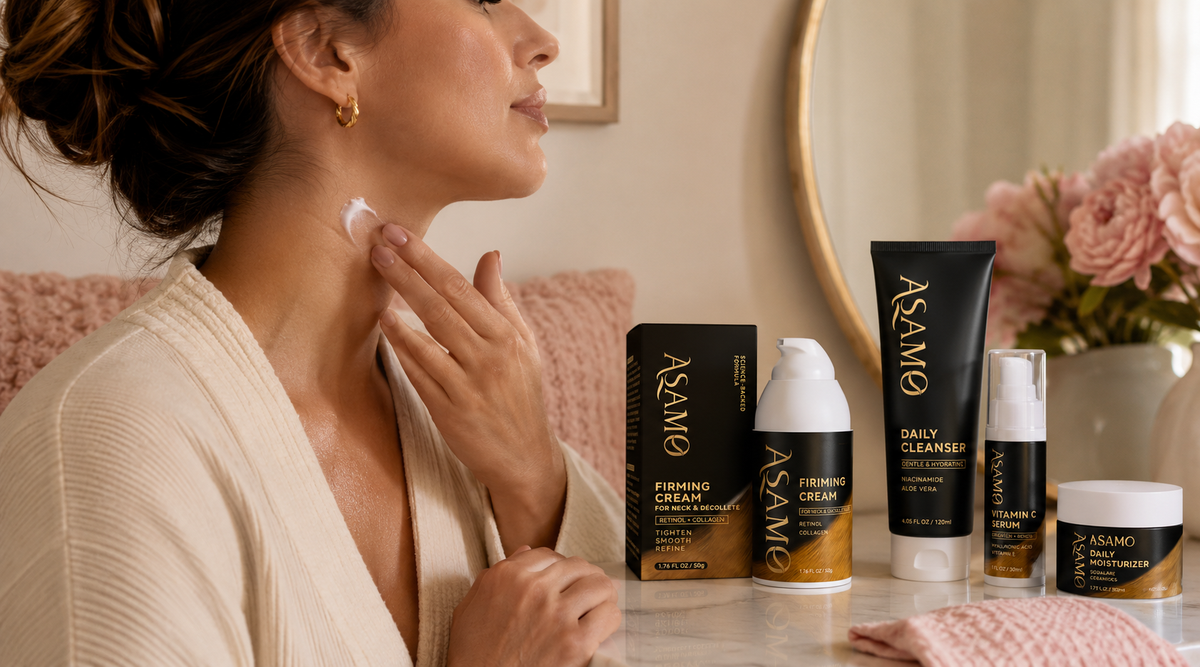
“How long to wait between skincare steps” is a practical skincare question, not just a question about rules. Most people want to know whether they need to pause between products, how to avoid pilling, and whether a longer wait makes a routine work better.
The short answer: there is no universal number of minutes. In most routines, you can apply the next product once the previous layer has spread evenly and no longer feels obviously wet, runny, or likely to slide around. Product labels, texture, amount, and comfort should guide the decision.
This guide focuses on everyday cosmetic use, product texture, layering, hygiene, and label reading. It does not diagnose skin conditions or promise treatment, permanent change, or results within a fixed time. Any ASAMO product-specific statement should be reviewed against the final formula, packaging, instructions, and finished-product testing.
Quick Answer
You usually do not need to set a timer between skincare steps. Let each layer settle enough that it is no longer visibly wet or moving across the skin, then continue.
A thin, fluid product may settle quickly. A richer cream, a larger amount, warm weather, humidity, or rubbing can make the next step feel less comfortable. If your routine pills or takes a long time to settle, reducing the amount or simplifying the layers is often more useful than waiting longer.
Start With the Product Label
The product label comes before any general skincare rule. It may state where a product is intended to be used, how often to use it, whether to avoid certain areas, and whether it belongs in a morning or evening routine.
Category names such as “serum,” “cream,” or “treatment” do not automatically tell you how long to wait. Two products with the same category name can have very different textures, packaging, and instructions.
When a product’s instructions differ from general advice online, follow the product instructions. If the label does not specify a waiting period, use the product’s surface feel and how it layers with the next step as your guide.
The American Academy of Dermatology also notes that product order matters in a routine, while specific products and instructions can differ. Read its general guidance on applying skincare products in order.
What “Settled” Actually Means
“Settled” does not have to mean completely dry, matte, or absorbed in a way you can measure. It simply means the layer has had enough time to stay in place without excessive slipping, dripping, or immediate mixing with the next product.
You can use these simple signals:
| What you notice | What to do |
|---|---|
| The product is still visibly running or gathering in areas | Give it a little more time before the next step. |
| The surface feels very wet and your fingers move the layer around easily | Use less next time or allow the layer to settle briefly. |
| The product has spread evenly and is no longer moving | Continue to the next step if the label allows. |
| The routine pills even after waiting | Reduce product amount, rubbing, or duplicated layers rather than adding a long delay. |
| The skin feels uncomfortable, stings, or becomes noticeably red | Stop using the product and follow the label or seek professional advice as appropriate. |
A routine should fit real life. If a product only works when you wait an impractical amount of time, that may be a sign that the amount, order, or number of layers needs adjustment.
Why There Is No Universal Waiting Time
Different skincare products behave differently after application. A single “wait 30 seconds” or “wait five minutes” rule cannot account for all formulas, climates, and routines.
Waiting time can change with:
-
Product texture, such as liquid, gel, lotion, or cream
-
The amount applied
-
Whether the product is layered over a damp or very rich previous step
-
Indoor temperature and humidity
-
Friction from hands, towels, clothing, makeup tools, or facial hair
-
The texture and instructions of the next product
For example, a lightweight hydrating layer may be ready for the next step quickly, while a richer cream can remain more noticeable on the surface. Neither situation automatically means the product is better or worse. They simply call for a routine that feels comfortable and works with the surrounding steps.
Apply Less Before You Wait Longer
Using more product does not automatically improve a routine. Too much product can create slipping, a heavy film, transfer to clothing, makeup movement, or pilling.
There is no fixed number of drops, pumps, or fingertip amounts that applies to every package. A pump, tube, jar, or dropper can dispense very different amounts. Start with the smallest label-appropriate amount that can be spread evenly over the intended area.
If you regularly find yourself waiting a long time between steps, test one change at a time:
-
Use less of the first product.
-
Spread it with fewer passes.
-
Remove a repeated product category from the routine.
-
Let the layer settle naturally.
-
Reassess whether the next product now applies more smoothly.
Changing only one variable makes it easier to understand what improved the routine.
A Simple Order for Most Routines
“Lighter to richer” can be a useful starting point, but it is not a replacement for label instructions. The goal is not to use every possible category. It is to make each step clear and comfortable.
| Routine step | General role | When to continue |
|---|---|---|
| Cleanser | Cleanses and rinses away | Pat skin dry or follow label directions. |
| Lightweight leave-on product | Often fluid, gel, or serum-like | Continue when it is evenly spread and no longer visibly wet. |
| Moisturizer or cream | Adds a more substantial final layer | Continue only if another label-approved step is needed. |
| Sunscreen in the daytime | Follows its own application and reapplication instructions | Apply according to the sunscreen label; do not rely on another product to replace it. |
Not every routine needs every row. A cleanser and one leave-on product may be enough for some people. In the daytime, sunscreen instructions remain important regardless of how minimal the rest of the routine is.
Morning Routines: Keep the Layers Practical
Morning skincare often needs to work with sunscreen, makeup, commuting, and limited time. This is not the moment to add extra layers simply because they exist.
A practical morning approach is:
-
Cleanse or follow your usual morning cleansing approach.
-
Apply any label-appropriate leave-on product in a small amount.
-
Let it settle until it is no longer visibly wet or moving.
-
Apply moisturizer if it is part of your routine and layers comfortably.
-
Apply sunscreen according to its own label instructions.
If makeup rolls, shifts, or pills afterward, do not assume that you need a longer waiting period first. Test a smaller amount, gentler application, or fewer layers. You may also prefer to reserve a richer product for the evening.
Evening Routines: You Still Do Not Need a Timer
Evening routines can make room for richer textures because makeup and daytime clothing are less likely to interfere. But night is not a reason to layer several unfamiliar products at once.
After gentle cleansing, apply products to the intended area with clean hands. Allow each layer to settle enough that the next product can spread without dragging or balling up. A shorter routine is easier to observe, especially when you are introducing a new product.
If a product label specifies nighttime use, frequency, or other directions, follow those instructions. Evening use does not override the amount, placement, or safety information on the package.
Pilling Is a Layering Issue, Not Proof That a Product Is “Working”
Pilling is when products roll into small bits on the skin. It can be frustrating, especially before makeup, but it usually relates to texture compatibility, too much product, repeated rubbing, or layers that have not had time to settle.
It is not a sign that a product is “activating,” nor does it automatically mean the product has failed.
| Possible cause | A practical test |
|---|---|
| Too much product | Cut back the amount of one product. |
| Repeated rubbing | Press or spread gently instead of massaging back and forth. |
| Too many overlapping layers | Remove one nonessential layer for several uses. |
| Rich product before a lighter one | If labels allow, test a more practical order. |
| Makeup or sunscreen interacting with skincare | Keep the rest of the routine the same and test one change only. |
| Clothing friction around the neck or jawline | Allow the final layer to settle and avoid overapplying near areas that rub. |
Avoid changing every product at the same time. A simple test gives you a more useful answer than a complete routine reset.
Gentle Application Helps More Than Extra Waiting
How you apply a product can affect the way it layers. Use clean hands and spread the product with light, controlled movements. There is no need to tug at the skin or keep rubbing until every trace of a product disappears.
Around the eyes, lash line, neck, and other sensitive areas, use only products that are clearly labeled for that location. Keep products out of the eyes and do not apply them to the inner eyelid or waterline unless the product specifically instructs you to do so.
Do not interpret burning, persistent stinging, or marked redness as evidence that a product is working. If discomfort continues, stop use, rinse or cleanse as appropriate, check the label, and seek professional guidance when needed. For concerning eye symptoms, obvious swelling, or severe reactions, seek timely professional help.
Texture Changes the Routine
A product’s texture tells you more about its routine behavior than a marketing category alone.
-
Fluids may spread quickly but can run if overapplied.
-
Gels may feel light but can pill if layered heavily or rubbed repeatedly.
-
Lotions often work well as an intermediate layer.
-
Creams may feel more substantial and may be better suited to routines with fewer products.
-
Oils and balm-like products can change how later products apply, depending on their instructions and the rest of the routine.
“Lightweight” and “rich” describe the experience of using a product. They do not prove that one formula is stronger, more effective, or appropriate for everyone.

Do Not Confuse Feel With a Proven Result
A cool sensation, smooth slip, quick-drying feel, or rich finish may make a product more pleasant to use. These are useful sensory observations, but they do not independently prove a particular biological effect.
Cosmetic content can describe texture, finish, moisturizing feel, appearance, and everyday use. It should not turn those observations into claims about treating conditions, permanently changing skin structure, or delivering a guaranteed result.
This distinction matters when building a routine. A product that feels comfortable and layers well may be easier to use consistently, but comfort alone is not proof of a specific outcome.
Read the Full Formula, Not a Single Featured Ingredient
An INCI ingredient list can help you identify ingredients you prefer or want to avoid. It usually cannot show the exact percentage of every ingredient, formula stability, delivery system, or the finished performance of the product on your skin.
When comparing products for a routine, consider:
-
The full ingredient list
-
The product’s stated use area
-
Directions and warnings
-
Packaging type
-
Texture and finish
-
Whether it works comfortably with your existing steps
-
Evidence that supports any specific product claim
A featured ingredient name should not be treated as a complete description of the formula.
Packaging, Hygiene, and Storage Matter Too
Pumps, tubes, jars, droppers, and applicators affect both product amount and hygiene. Keep product openings and applicators clean, close packaging promptly, and avoid placing applicators on unclean surfaces.
Do not add water, saliva, or another cosmetic product to change a product’s texture. This can affect the formula and increase contamination risk. If a product develops an unusual smell, color, or texture, do not try to “fix” it by mixing it with something else.
Unless the label says otherwise, store cosmetics in a cool, dry place away from direct sunlight and prolonged heat. Avoid transferring products to unmarked containers that remove instructions, ingredients, batch information, or warnings.
Build a Routine You Can Reassess
A routine does not need to stay identical all year. Travel, weather, makeup habits, and comfort can all change what feels practical.
When reassessing, start with the basics:
-
Is every product used in the area allowed by its label?
-
Is the amount reasonable for the packaging and target area?
-
Are two products doing an overlapping job?
-
Does one layer make the next one pill, slide, or feel uncomfortable?
-
Would a simpler morning or evening version work better?
Reassessment does not mean replacing everything. Often, a small adjustment to amount, order, or texture is enough.
How ASAMO Can Fit Into a Routine Conversation
ASAMO can use this topic as an educational entry point rather than a promise-driven sales page. The article should help readers understand routine order, amount, texture, and label directions before inviting them to explore a relevant collection or product page.
Any future ASAMO product-specific statement should match the final formula, packaging, instructions, and finished-product evidence. Do not add unverified product URLs or create blank links before the corresponding page is live.

Frequently Asked Questions
How long should I wait between skincare steps?
There is no fixed number of minutes for every formula. Continue when the previous layer is evenly spread and no longer obviously wet, runny, or likely to move around.
Do I need to wait until every product is completely dry?
Usually, no. You do not need to wait for a completely matte or dry-to-the-touch finish unless the product label says so. The practical goal is a layer that has settled enough for the next product to apply comfortably.
What if my skincare pills?
First, use less product, rub less, and remove one overlapping layer. Test one change at a time rather than changing your entire routine at once.
Does waiting longer make skincare work better?
Not automatically. Extra waiting time is not a universal measure of product performance. Follow the label and focus on comfortable, even application.
Can I use a richer product at night?
If the label allows, a richer texture may feel more practical at night because there is less interference from makeup and daytime activity. Keep the routine simple when trying something new.
Should sunscreen be the last skincare step in the morning?
Follow the sunscreen’s own label instructions for use, coverage, and reapplication. In many daytime routines, sunscreen is applied after other skincare steps, but the product label should guide your use.
When should I stop using a product?
Stop use if you experience persistent burning, marked redness, obvious swelling, eye symptoms, or another concerning reaction. Follow the label and seek professional guidance as appropriate.

The Takeaway
You do not need to measure skincare waiting time by the clock. A better rule is to apply each product in a suitable amount, let it settle until it no longer feels overly wet or mobile, and then move to the next label-appropriate step.
Keep the routine clear, gentle, and easy to repeat. If products pill, feel heavy, or do not layer comfortably, reduce the amount or number of steps before adding a longer wait. And if a product causes persistent or concerning discomfort, stop using it rather than treating irritation as proof that it is working.
ASAMO should update any product-specific wording only after the final formula, testing materials, label directions, packaging, and live URLs are confirmed.
Share:
How to Build a Simple Night Skincare Routine
Why Does Skincare Pill and How Can You Reduce It?