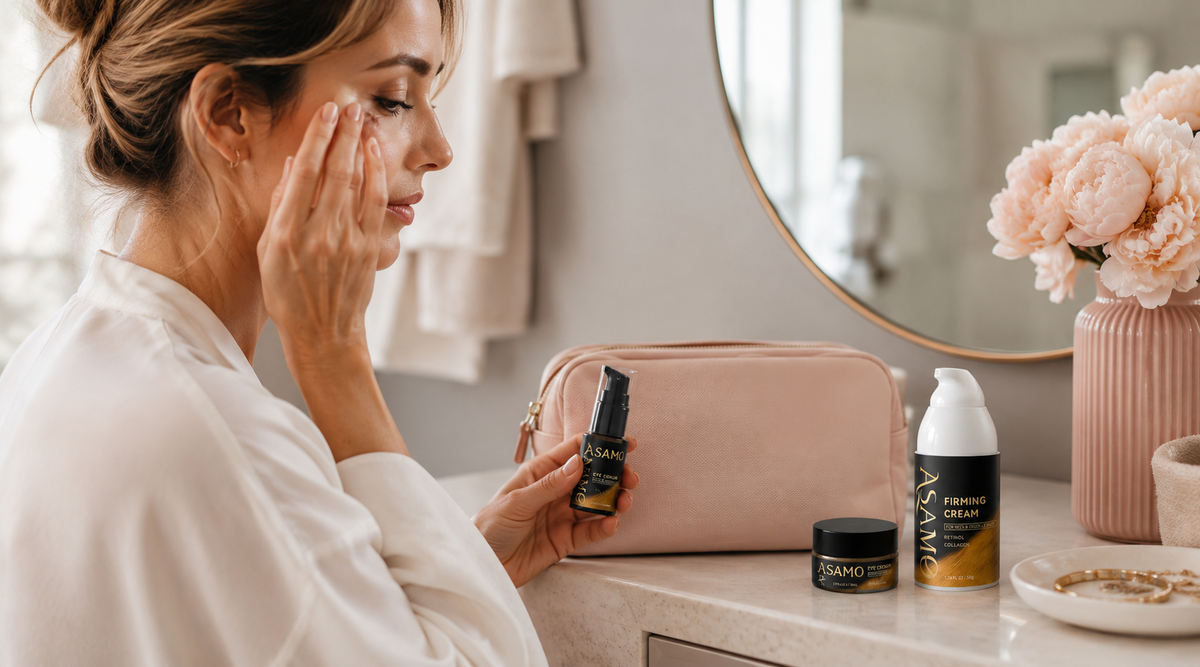
A “travel skincare routine” should make daily care easier, not turn your suitcase into a second bathroom cabinet. Travel often changes your schedule, water access, climate, luggage space, and the amount of time you want to spend on a routine.
The most practical approach is to keep the basics: cleansing, moisturizing, and daytime sunscreen. Choose products you have already used, with clear labels and packaging that is less likely to leak.
This guide focuses on everyday cosmetic use, product texture, layering, comfort, hygiene, and label reading. It does not diagnose skin conditions or promise treatment, permanent change, or fixed results. Any ASAMO product-specific wording should be updated only after the final formula, packaging, directions, and finished-product testing are confirmed.
Quick Answer
For travel, prioritize the products you already know how to use: a cleanser or cleansing option, a moisturizer or other familiar leave-on product, and sunscreen for daytime use according to its own label.
Bring fewer products with clear directions instead of a collection of unfamiliar samples. A routine that is easy to pack, clean to use, and comfortable with your travel schedule is more useful than one with the most steps.
Start With What You Already Know
Travel is usually not the ideal time to introduce several new skincare products. A new climate, long flight, changed sleep schedule, unfamiliar hotel environment, or extra makeup can already affect how a routine feels.
If you add new products at the same time, it becomes difficult to tell what caused pilling, heaviness, dryness, or discomfort.
Before packing, choose products that you have already used comfortably. This gives you a familiar baseline while other parts of your routine change.
A simple travel routine can be built from products that have clear roles:
| Product type | Travel role |
|---|---|
| Cleanser or cleansing option | Helps you remove daily buildup, sunscreen, or makeup according to your usual routine. |
| Familiar leave-on product | Adds one simple step that you already understand. |
| Moisturizer | Helps create a comfortable final layer if it fits your routine. |
| Sunscreen | Daytime step used according to its own label. |
| Optional eye or neck product | Bring only if it is already part of your familiar, label-appropriate routine. |
You do not need every category on every trip.
Read Labels Before You Pack
The product label is the best place to confirm intended use area, frequency, warnings, storage instructions, and whether the product should be used at a particular time of day.
A label also helps when you are away from home. If you transfer a product into an unmarked travel container, you may lose its directions, ingredient information, warning statements, and batch details.
Before packing, check:
-
Is the product intended for the area where you use it?
-
Do you know how often the label recommends using it?
-
Does the product have a cap, pump lock, or other packaging feature that reduces leaking?
-
Does it need specific storage conditions?
-
Is the package still in good condition?
-
Have you used the product before?
When general online advice differs from your product directions, follow the product label.
Keep the Routine Short
A travel routine works best when each step has a clear purpose. More products can mean more leakage risk, more weight, more layers, and more uncertainty.
A basic daytime routine may include:
-
Cleanse if needed.
-
Apply one familiar leave-on product in a small amount.
-
Add moisturizer if it fits comfortably.
-
Apply sunscreen according to its own label.
A basic evening routine may include:
-
Cleanse gently.
-
Apply one familiar leave-on product if part of your routine.
-
Apply moisturizer or another familiar final layer if desired.
This is not a fixed rule for every product. Labels, texture, travel conditions, and personal comfort should guide your actual routine.
Bring Fewer, Familiar Products
Travel can be a good reason to reassess what you actually use. If a product does not have a clear role in your everyday routine, you may not need to pack it.
A practical packing filter is:
-
Bring it if you already use it comfortably.
-
Bring it if the label is clear.
-
Bring it if it serves a distinct role.
-
Leave it at home if it duplicates another product.
-
Leave it at home if it is unfamiliar and you do not need it for the trip.
-
Leave it at home if its packaging is likely to make travel inconvenient.
A shorter routine can also make it easier to notice whether heat, cold, dry air, humidity, or travel makeup changes the way products feel.
Packaging Matters More When You Travel
Travel can put products through temperature changes, movement, pressure changes, and crowded bags. Packaging affects hygiene, amount, and the chance of leaking.
Pumps, tubes, jars, droppers, and applicators all have different practical strengths. There is no single best format for every product, but packaging should be considered before you pack.
| Packaging type | Travel consideration |
|---|---|
| Tube | Often convenient for controlled dispensing; check that the cap closes securely. |
| Pump | Can be practical if it locks or has a secure cover. |
| Jar | May be less convenient if you need to dip in repeatedly; use clean hands. |
| Dropper | May require extra care to prevent leaks and keep the dropper clean. |
| Wand or brush applicator | Keep the applicator clean and avoid contact with unclean surfaces. |
Close every product securely. If you use a travel container, make sure it is clean, appropriate for cosmetics, and clearly labeled with the product name and essential use information.
Do not mix products together to save space. Mixing can change texture, interfere with directions, and increase contamination risk.
Use the Smallest Appropriate Amount
When luggage is limited, it can be tempting to overpack a product “just in case,” then overapply it because you brought it. A small, label-appropriate amount is usually more practical.
Too much product can create:
-
Pilling
-
A heavy or sticky finish
-
Transfer to hair, clothing, pillowcases, or masks
-
Makeup movement
-
A longer wait before the next step
-
More frequent need to clean product buildup from hands or packaging
Start with the smallest amount that spreads evenly over the intended area. Packaging varies, so there is no universal number of pumps or drops.
Travel Conditions Can Change Product Feel
A product may feel different during travel without the product itself being “stronger” or “weaker.” Climate, temperature, humidity, air conditioning, heating, and changes in routine can all affect the surface feel of cosmetics.
For example:
| Travel condition | Practical adjustment |
|---|---|
| Warm or humid weather | Use lighter amounts and reduce unnecessary rich layers. |
| Dry indoor air | Consider whether a familiar, more substantial texture is more comfortable. |
| Flights or long transit days | Keep the routine simple and avoid introducing unfamiliar products. |
| Beach, city walking, or outdoor travel | Follow sunscreen directions for application, coverage, and reapplication. |
| Cold weather | Use products in a way that follows labels and feels comfortable under clothing. |
| Heavy makeup days | Keep skincare layers practical to reduce movement or pilling. |
These adjustments are about comfort and routine fit. They do not prove a particular product effect.
Morning Travel Skincare: Plan Around Sunscreen
Daytime travel can include walking, driving, outdoor activities, airport time, sightseeing, and makeup. Your morning routine needs to work with those realities.
Keep the layers manageable. If you use a familiar leave-on product, apply a small amount and let it settle until it is no longer obviously wet or moving. Add moisturizer if it is part of your routine, then use sunscreen according to its own product label.
Sunscreen directions for amount, application, and reapplication should remain separate from general skincare advice. Do not mix sunscreen into moisturizer or another product to save a step. Follow the sunscreen’s instructions instead.
If your routine pills under sunscreen or makeup, reduce the amount of skincare beneath it or remove an overlapping layer before adding more waiting time.
Evening Travel Skincare: Return to the Basics
At night, you may have sunscreen, makeup, sweat, or travel-day buildup to remove. A simple evening routine is often easier to maintain than a complicated one.
After cleansing, use familiar, label-appropriate products. If you use a richer moisturizer or cream at home, evening may be the more practical time to use it while traveling, provided the label allows.
Avoid turning the first night in a hotel into an experiment with multiple new samples. A stable routine is easier to observe and less likely to create unnecessary confusion.
You Do Not Need to Measure Waiting Time
Different formulas do not have one fixed waiting time. Product amount, temperature, humidity, and the texture of the next product all affect how a layer settles.
A practical approach is to continue once the previous layer:
-
Has spread evenly
-
Is no longer visibly wet or runny
-
Does not feel likely to move around
-
Allows the next step to apply comfortably
If you have to wait a long time to stop pilling, use less product or simplify the layers. Adding extra minutes is not always the most effective solution.
Reduce Pilling on the Road
Pilling often comes from too much product, repeated friction, overlapping texture films, or layers that have not settled enough. It is not proof that a product is “activating.”
When pilling happens, test one change at a time.
| If this happens | Test this adjustment |
|---|---|
| Products pill during your routine | Use less of the first leave-on product. |
| Pilling begins under sunscreen | Simplify the layers underneath and use gentle application. |
| Makeup shifts or rolls | Reduce skincare amount and use less friction with tools. |
| Pilling occurs near the neck or hairline | Use less product where clothing, hair, or masks rub. |
| Pilling starts after trying a hotel sample | Pause the unfamiliar product and return to your baseline routine. |
| You cannot identify the cause | Keep only cleanser, familiar moisturizer, and sunscreen in the routine temporarily. |
Do not change everything at once. One controlled adjustment is more useful than replacing every product in your bag.

Keep Hygiene Simple Away From Home
Travel surfaces may be less familiar than your bathroom counter. Keep product openings, caps, droppers, and applicators clean. Wash your hands before applying leave-on skincare when possible.
Avoid placing applicators directly on hotel counters, airplane trays, or other unclean surfaces. Close products promptly after use and do not share applicators with others.
Do not add water, saliva, or another cosmetic to thin or change a product’s texture. This can affect the formula and increase contamination risk.
If a product develops an unusual smell, color, or texture, do not try to repair it by mixing it with something else.
Store Products With Care
Unless a label says otherwise, most cosmetics are best stored in a cool, dry area away from direct sunlight and prolonged heat. Avoid leaving products in a hot car, in direct window light, or near a strong heat source for long periods.
A bathroom can be convenient, but hotel bathrooms may have changing heat and humidity. If possible, keep products closed and stored in a clean toiletry bag or drawer away from direct water spray.
Do not transfer products into unlabeled containers if that means losing essential safety or use information. Clear labeling makes your travel routine safer and easier to follow.
Avoid Treating Samples as a Full Routine
Travel is often when people receive or purchase samples. Samples can be convenient, but several samples at once can turn a stable routine into a confusing test.
If you decide to try a sample, do not also introduce multiple new products. Keep the rest of your routine familiar and follow the sample’s directions carefully.
For products used near the eyes, use only products clearly labeled for that area. Keep cosmetics out of the eyes and do not use them on the inner eyelid or waterline unless the product specifically directs you to do so.
Know When to Stop Using a Product
Travel discomfort should not be dismissed as something you have to “push through.” Do not interpret persistent burning, stinging, marked redness, or swelling as proof that a product is working.
Stop use if you experience persistent or concerning discomfort. Cleanse or rinse as appropriate, read the product label, and seek professional guidance when needed. If symptoms are severe or involve the eyes, seek timely professional help.
How ASAMO Can Fit Into a Travel Routine
ASAMO can use this topic as an educational entry point: help readers identify a simple routine, choose familiar products with clear labels, and pack according to their actual travel needs.
The article should not suggest that every traveler needs a complete set of products. A more useful message is that a small number of well-understood products can make a routine easier to maintain.
Any ASAMO product-specific statement should be reviewed against the final formula, packaging, label instructions, and finished-product evidence before publication.

Frequently Asked Questions
What skincare products should I bring when traveling?
Start with familiar products that cover your basic routine: a cleansing option, a moisturizer or other familiar leave-on product, and sunscreen for daytime use according to its own label.
Should I try new skincare products while traveling?
It is usually easier to travel with products you already know. Introducing several unfamiliar products can make it difficult to identify the cause of pilling, discomfort, or layering issues.
How can I prevent skincare from leaking in my luggage?
Choose packaging that closes securely, check caps and pump locks, keep products upright when possible, and place them in a separate clean bag. Do not rely on a loose cap alone.
Can I use the same skincare routine morning and night while traveling?
It depends on the product labels and your routine. Morning products need to work with sunscreen and daily activities, while evening may be more practical for richer textures.
Do I need to wait between travel skincare steps?
There is no fixed waiting time for every formula. Continue when the previous layer is evenly spread and no longer visibly wet or moving.
What should I do if products pill during travel?
Reduce the amount, use less friction, and remove one overlapping layer. Change one variable at a time rather than replacing your full routine.
When should I stop using a product while traveling?
Stop use if you experience persistent burning, marked redness, obvious swelling, eye symptoms, or another concerning reaction. Follow the label and seek professional guidance as appropriate.

The Takeaway
A travel skincare routine should be familiar, simple, and easy to use. Prioritize cleansing, moisturizing, and daytime sunscreen, then add only products that have a clear role and work comfortably in your usual routine.
Choose secure packaging, use small appropriate amounts, keep products clean, and avoid introducing several new items at once. If the routine starts to feel heavy, pill, or cause persistent discomfort, simplify and return to the basics.
Share:
How to Introduce One New Skincare Product at a Time
How to Adjust Your Skincare Routine Between Seasons